Theresa Lin
Nonfiction
The Most Beautiful Thing
For our final class of the semester, we read Borges’s short story “The Aleph.” In his deceased lover’s basement, a man encounters “a small iridescent sphere of almost unbearable brilliance.” Beholding it, he witnesses all angles of the universe at once:
I saw the teeming sea; I saw daybreak and nightfall; I saw the multitudes of America; I saw a silvery cobweb in the center of a black pyramid…I saw bunches of grapes, snow, tobacco, lodes of metal, steam; I saw convex equatorial deserts and each one of their grains of sand; I saw a woman in Inverness whom I shall never forget; I saw her tangled hair, her tall figure, I saw the cancer in her breast…
Tear down the house, the man tells his late lover’s brother. There is no use for the Aleph since, to the man, his lover was the universe and now she is gone. When the man attempts to capture the Aleph in words, he is frustrated by the successive nature of writing. How can he possibly relate this experience of simultaneity when sentences necessarily follow one after the other? And even then, how can he do justice to the totality of all that he felt and gazed upon when, even if he spent his entire life chronicling that single instance, his account would only ever be incomplete, partial?
We go around the room and take turns reading. There is a whole page of this swelling, mesmeric imagery but the passage lands on an inward student who stumbles over the words. His hesitancy detracts from any feeling of awe that the sentences could have impressed. At any point, he could defer to his classmate but stubbornly—either out of virtue or a stupid pride—he persists to the end.
I chose the story for the last class to connect the limitation of words with the finite nature of the semester. We have only scratched the surface, I suggest. Seniors often ask me how they might continue writing after they graduate. This story attempts to alleviate that concern. They know enough. This story is also a comfort to me, since recently it has been a great source of anxiety just how much writing has come at the cost of really living. “Despite the limitations of language, language is also the only way we experience the Aleph at all,” I hear myself say a little meekly. I am suddenly aware that this moment calls for the drama of some sort of benediction but I have neither the surplus of confidence nor the optimism in writing that this type of sendoff requires. Of course, writing is a way we might experience life more richly. How often do writers say that it is only through writing that they really understand what they or others are thinking? That is not what I mean here. I mean that I am getting older and I am tired of attempting to capture infinity. Tear it all down.
Instead of getting to say goodbye to each student at the door, a very nervous student comes up to me to explain why she believes her final portfolio was accidentally misprinted. “I don’t know what happened,” she mumbles quickly. Standing, I am reminded how tall she is. She is like a fiddlehead unraveling before my eyes. “I don’t know why my edits weren’t saved.” “It’s fine,” I tell her. More and more students walk out the door behind her. “Are you sure?” she asks. “Yes, it’s fine,” I repeat. Nearly all of them are gone by now. “I can get it to you by tonight,” she says. “There’s no need for the rush,” I say. “Take until tomorrow, after your finals are done.” She is one of those people that cause you to repeat and repeat the same thing, and no amount of clarity or reassurance will hurry things. “Oh, thank you,” she gushes. By now, everyone has left. Eventually she leaves as well. Another semester ends unceremoniously.
In the same silence as I had entered the room hours before, I wheel my suitcase out of the corner where it is hidden. I look at my route on my phone, which shows in colored lines how I will take the subway to JFK. After that, I will take the plane headed for O’Hare, then the CTA Blue line to LaSalle station, then a Lyft to the rehearsal dinner in downtown Chicago for the wedding of Morgan’s law school roommate Jack. Morgan flew out that morning already. He met up with his childhood friend Owen at the hotel bar. “I’m already a little tipsy,” he texts playfully.
It feels silly that I’m not there having a drink with him. I chose a later flight so as not to miss this final class for a job that is not even full-time. I convinced myself it was for the principle. It was something that someone who felt pride in their job would do. Recently though, I am unsure what my principles should be. I am writing a little here and there and publishing sometimes in smaller outlets, teaching a couple classes at the college—all they would give me—and teaching some community classes at night. I work until 9 at my laptop while Morgan plays tennis with someone else or while he reads or finishes the crossword or watches a movie by himself on the couch. Then after he goes to sleep, I come back out, unsatisfied where I left things. I type some more until 1 AM. If I push a little harder, I think, I will finally break through and then I can relent.
In a restroom stall by my gate, I change into a bright red dress. The crinkled texture usually makes me feel cocooned and powerful. Today, the dress is red as the blood of a leper against the brightly lit terminal that goes on and on and the muted travelers walking itinerantly to their destinations.
The plane takes off and all of New York compresses into the small window.
~
At the rehearsal after-party, we are drinking at Bub’s, a honky tonk which Jack and Emma frequent with their friends. The women all look like Emma, tall and clean like the Ladies’ Day interns Plath describes who have painted nails and Bermuda tans. A woman knows another woman’s efforts and, usually, these efforts seem like a waste of time to me, only tonight, it is as though by being a group they’ve surpassed a critical mass, tipping the scale toward beauty as superior virtue. And why shouldn’t it be? It is the ultimate celebration of ephemerality. Someone steams the creases from her silk dress, rouges her cheeks, lotions her ankles—by morning, the dress is on the floor, the face and body are washed. There is almost less egoism in their adornment of the self than there is in the writing done for a reader. There is the secret hope on the part of the writer that she will be entered into the Pantheon of writers and recognized by her peers and then by posterity. My suitcase sits in the corner of the bar like a wart with my oversized shoulder bag perched on top. Inside is “The Aleph.”
The wedding takes place in one of the nicest steak and seafood restaurants in all of Chicago. Dinner overlooks the river. Along the hall entering the ballroom, Jack and Emma have lined the ledges on either side with photographs of their ancestors. “It reminds me of that song,” Morgan says. “Thank your father before you, his mother before him. Who would I be without you, without them?” Beneath the ledges, hundreds of candles emit a strong heat. Emma resembles her Mexican great-grandmother, whose pin curls and skin tone rendered in sepia remind me of the portraits of the dead in the Recoleta Cemetery in Buenos Aires. It was terribly humid and there were many mosquitos the day I visited. A number of the mausoleums were in terrible states of disrepair—some floors were rotted through so that we could see the staircase leading directly down into the crypt where entire families’ caskets were stacked one on top of the other. It was not only the floor that had deteriorated, but that permeable barrier between understanding death intellectually and feeling it viscerally with an uncontrollable racing of the heart. Further along the hall, there is a photo of Emma’s first Shih Tzu. Then another of her current Shih Tzu. Has she always had this breed? There is no question of where she or Jack come from, or even their dog. There is no question of who they are or where they are going. Morgan said they will have a baby in a year. They will move close to the hometown where they met, close to both their parents who will help with the baby. Many of their friends already moved back or they never left. After the first baby, they will have a second, maybe a third. Once the children are in grade school, Jack looks forward to coaching their little league. In thirty years, they will be the ones giving the speeches at a wedding just like this one. It will be their photos along the wall.
The next morning, hungover, Morgan swims in deliberate lines back and forth in the hotel pool. Meanwhile, I lurch like a frog with my head above the water. At the end of the lanes, catching our breath, I say, “I’m surprised by how tempting their life seems to me. How sturdy it seems when I only thought about it as stifling before.”
“I know what you mean,” says Morgan. When I met him, he’d been disinterested in ever becoming a parent. “We have each other,” he said back then. “Besides, I don’t need a legacy.” Now, if it were up to him, we’d be living in the suburbs of Southern California where every day is sunny, and we’d have a kid. We’d eat beautiful dinners, I’d take the kid to the pool, then over to the courts to watch him play tennis, and we’d end each night with red wine. “What changed?” I asked him before. “I only ever saw France, really, and a little of Spain before we met. Now I’ve seen Japan, Taiwan, Argentina, Portugal, Hungary, Italy—I’ve seen enough.”
I’m the one who still insists on our life in New York. But what is here?
“I’m sure they’re thinking the same about us,” says Morgan trying to cheer me up. “I’m sure that our childless life in New York seems exciting to them.”
“I don’t think so,” I say. “Everyone thinks it’s ridiculous.”
Yesterday, while I was walking through the Art Institute, Morgan was sitting in a trolley with the rest of the wedding party taking pictures and occasionally waiting on Jack and Emma who took their own portraits and exchanged their vows in private. “I think if we could do our wedding again, I would do our vows like they did, just between us,” says Morgan. “I’m not sure about what I said anymore.”
“But you’d always thought so highly of vows,” I say, shocked. In his vows, he quoted Plato’s Symposium, the part about two halves of the same soul traversing the world to find the other to be whole.
“I still do. I’m just thinking now, maybe other people don’t need to hear them. I preferred yours, how you talked about a typical day that we spend together.” I remember the day that inspired my writing of all our days. It was the kind of weekend afternoon that typically sends me into a panic as I begin thinking that I should be doing something fun, only I have no idea what. Usually, I turn back to work to give me some sort of direction, like someone who depends on guzzling their first Bloody Mary of the day to feel aligned again. But on this afternoon, Morgan and I were seated outside, under a tarp at a Mexican restaurant, talking, and I didn’t feel those usual compunctions about wasting time. We slowly finished our margaritas and the afternoon passed pleasantly as the ice melted.
Later, at home, I reread my vows. I’d quoted a poem titled “What Is Beautiful” by someone named Alice Rose George that had meant a lot to us those first two years.
…the snow went into its night cycle.
Quickly time changed, they slept,
they woke to an ice-melt of memory.
In the aftermath they shoveled what was left
aside, making new images of spring…
Strangely, even though most of the poem is the couple spending time together, doing various things as they tend to the home in this winterscape, the speaker concludes, “It is words, the most beautiful thing.” I felt sure of it then, but, preparing to frog my way across the lane again, I am thinking, the body in the pool is truer. The lungs expand and contract. The limbs thrash in the water until they tire. The body either sinks or floats.
And Pleasure Tunes My Tongue
The next weekend, we are in Cape Cod for another wedding, this time for one of my colleagues, Bill, from the Writing Center.
Another colleague, Silas, who dresses in hand-sewn linen sets and drinks green tea, officiates. He looks uncharacteristically worn out. He has apparently been on the property for days. They have operated as a commune helping to set up—everything was assembled by the guests, the flower arrangements, the chuppah, the cocktails. He strikes a small percussive bowl and the bride’s sisters, two grown women who look like variations of the bride, one skinnier and one plumper, come prancing out like woodland nymphs sprinkling petals from woven hand baskets. Silas strikes the bowl again and the bride and groom appear from opposite ends of a half circle, almost leaping into position under the chuppah, a soft pink floral blanket I learn later was embroidered by Bill’s grandmother. They stare fixedly, resolutely at one another, perhaps out of love, likely out of nerves. We sing a 1700s hymn: Palms of both my Hands I have engrav’d / Love’s Name; My hands shall hold you all our days…And tend the life we claim…And pleasure tunes my tongue. The bowl strikes again and someone reads a poem adapted from Rumi. If all the flutes in all the world were to vanish, music could still be produced from an outpouring of love, is the sentiment. It makes me think that someone could be stripped of those markers of a life: a house that is property, a job that is powerful and high-paying, even the instruments to make music. Even then, the throat would be able to produce the effervescent trill of woodwind.
I am back in the land of language, I think. Things feel righted again.
I am sitting next to Cecilia, who hasn’t worked in the center all this year. She got a prestigious fellowship in the desert, a fellowship I only learned about when reading a book by a recent Pulitzer Prize finalist who wrote about her time there. Even though Cecilia doesn’t yet have a book, I can feel that one is imminent. She is always winning things and publishing. She is a literary editor of a New York publication and, as usual, she appears enviably mysterious to me, swathed in layers of luxurious black.
The center folks are seated by the ice bed of seafood that seems to emanate even more cold into the already-frigid tent. It is an uncharacteristically chilly evening in late May. Later, a small girl who has thrown her scarf over her shoulders, so that the long strips hang off her back in a manner that looks humorously mature or Parisian for being 8 years old, weaves her way through the round tables. Cecilia invites her to dance. Soon, Cecilia is folded at her waist dancing in the corner of the tent while the girl is jumping spastically around. “Kathleen, join us,” shouts Cecilia. Kathleen glares. She is reticent, and even though she is wearing a kaftan and has eased somewhat from all the wine and the much smilier presence of her husband, she turns away from Cecilia and the girl as if they are both children.
Cecilia bends forward before popping up as though she is being resurrected over and over. I join them, but evidently too reservedly for Cecilia’s taste, since she shouts at me, “Weirder! Make it weird!” And so I go limp in the forearms and shake my head like a dog. Dancing is truer than language. Movement transpires independently of thought.
It is much too early for a conga line, but one is forming in the crowded tent. We have to watch out for our knees and guts with all the hard wooden edges of folding chairs. Pleasure tunes my tongue, and it is language that emerges even while dancing. “I feel like I’m in a Fellini film,” I shout to Cecilia. I am thinking of the end of 8½, after Guido has been tortured about making a film, when all the characters of his memory, daydreams, and life coalesce and dance arm-in-arm at the base of the tall scaffolded structure constructed for the movie that never was or, rather, never became.
“More Fellini!” Cecilia shouts back from her radiant face.
Later, when we are all getting cocktails at the bar manned by Bill’s friends, I ask, “What is the most appalling thing a student’s ever brought into the center?”
For me, it was a clear disc with a white specimen inside. It was part of the student’s recent art show. It was his semen, he told me later.
“A student wrote an essay from his perspective…” begins Kathleen.
And only because Kathleen is finally really drinking, “Not his perspective,” I squeal.
It turns out the student had written a paper from the perspective…of Phyllis Wheatley.
“A white man?” asks Cecilia. “I can’t hold it anymore,” she says, her knees buckling. We’d been planning to walk to the main house up the road. Everyone says it is gorgeous and that I should see it, but the walk is too long, and it is raining. There are “luxury porta potties” right outside but we are skeptical.
The porta potties turn out to be very nice. There is even a skylight and a little seating area to touch up one’s makeup. Cecilia, who is already swaying before entrées, looks up from washing her hands and into the mirror. “You look like you’ve been on the road,” she says to herself disparagingly. She runs her long, delicate fingers through her hair.
Cecilia will be staying on the property, in “the shed” as she keeps calling it. The groom’s best man, a hunky Austrian who later puts on the gypsy punk song “Start Wearing Purple,” will also be staying in the shed. “Ask him to help heat up the bath water,” we tease her. It needs to be warmed with hot stones, I have no idea. The rain comes down on the tent, the three-piece all-women jazz band keeps up a folksy rasp on the drums and the reedy whine of a clarinet.
“Bill told me it’s the same bath that Kahlil Gibran wrote The Prophet in,” Cecilia shouts over the music. Everything is romantic for Cecilia. Next month, she is off to Scotland. She’d been awarded another residency.
“A castle?” we take turns repeating. Earlier, she had called herself a vagrant.
“It’s not like that,” she says. “I mean yes, it is a castle, but right before the wedding, I visited my storage unit”—her relationship of many years ended abruptly, and she needed to move out—“and there were droppings all over my belongings. There’s some sort of little creature,” she says quietly. “It’s sad, really.”
“I’m always envious of what you are doing,” I say.
“Me?” she says. “You’re the most put-together person I know.”
Later, we move back into the wooden room where the ceremony was held earlier. The band has set up inside. The chairs have been cleared for dancing. The bride and groom are tossed onto chairs and everyone races around them in a frantic circle. Cecilia dances as she had earlier, freely and weirdly, only she bumps up against someone and loses her balance. Later in the night, she falls onto the floor, still smiling, before someone helps her up. Over and over she stumbles and over and over someone guides her by her forearm back up. She seems so vulnerable to me.
We dance and dance until midnight. Morgan and I say our goodbyes.
Cecilia smiles like she has all evening, still very beautiful and graceful even after falling so many times. Somehow that doesn’t detract but only adds to her playful fragility. It is something that others have long lost or domesticated or worse, never had.
Inside Out
I have never read The Prophet. Before I begin, I read about Gibran’s life. From the Poetry Foundation:
Though he considered himself to be mainly a painter, lived most of his life in the United States, and wrote his best-known works in English, Kahlil Gibran was the key figure in a Romantic movement that transformed Arabic literature in the first half of the twentieth century….These pieces spoke to the experiences and loneliness of Middle Eastern immigrants in the New World. For Arab readers accustomed to the rich but difficult and rigid tradition of Arabic poetry and literary prose,…Gibran’s simple and direct style was a revelation and an inspiration.
There is something about going outside the culture that paradoxically allows the writer to see something that those within it cannot. There’s something about the new articulation that awakens the ear. Gibran, himself, was a prophet, it seems.
Finally, I begin. The prophet Almustafa sees a ship emerging through the fog. After twelve years, in the season of harvest, he is being called home. But before he leaves, the city dwellers crowd him to ask him for guidance on questions on love, freedom, even buying and selling, time, good and evil, and death. The chapters are titled in such a way that they recall for me Francis Bacon’s The Essays and I am reminded how desperately people across time and culture seek practical and spiritual direction.
Because we were just at a wedding, I choose “On Marriage” to read.
Then Almitra spoke again and said,
And what of Marriage, master?
And he answered saying:
You were born together, and together
you shall be forevermore.
You shall be together when the white
wings of death scatter your days.
Aye, you shall be together even in the
silent memory of God.
But let there be spaces in your togetherness,
And let the winds of the heavens dance
between you.
Give your hearts, but not into each
other’s keeping.
For only the hand of Life can contain your hearts.
And stand together yet not too near together:
For the pillars of the temple stand apart,
And the oak tree and the cypress grow
not in each other’s shadow.
How much does life now resemble life as I’d always known it growing up—the hours passing quietly under lamp light, writing, reading, alone? Only I am not alone. How many nights has Morgan come and put his hands on my shoulders and kissed the top of my head?
I often think about the year we lived in California for his work shortly after we got married. We were laying on the bed following a visit to The Getty, and I told Morgan how much I liked the image of heaven as a group of people who were happy to see us, welcoming us with strings and song. I read on the wall plaque that Dutch artist Gerrit van Honthorst had studied cathedral ceilings in Italy before painting that work displayed on the ceiling.
“It’s actually titled Musical Group on a Balcony,” he said.
I’d missed that it was an earthly scene.
I pulled the image up on my phone and looked again at the especially warm, expectant faces of the singers leaning over the banister. Their gaze felt inevitable, as though they had been waiting all along to receive us in this moment. There was nothing for which we needed to atone. Come as you are, they seemed to suggest. How quickly other things fell away. How I wished this were heaven.
But what was the difference between an earthly scene and a heavenly one? The mandolins are playing in dizzying rounds, clear voices like cool ribbons weave between the pockets of sound, drawing me upward toward them. I hear the harp. And the trumpet song. There is a choir singing. It is incredible to think that this blissful period won’t be a coda forever. One day, it will simply be how things have been for most of my life.
Home of the World
It takes four hours to get home from Cape Cod. I insist on driving. “I didn’t retake the test for nothing,” I say. Recently, Morgan took a day off of work to accompany me to my road test out in Red Hook. When I failed, he said, “The guy was a prick.” He took another day off for my second test, this time in the Bronx. When I passed he said, “That guy was also a prick, but you learned from the first guy.”
We leave early hoping to beat Memorial Day traffic. All along I-95, the LED signs read: Drive sober. Live to grill another day.
We haven’t figured out how to fix the audio in the car we borrowed from a friend. The music sounds like it is being played from far away or under water. At some point, we just talk instead. Morgan says, “I was very moved by the singing.”
“They’d practiced it all afternoon the day before,” I add. “That’s how a lot of them met, in choral groups. I liked the line of the poem about coming home with happiness to one another.”
“I liked that too.”
Welcome to Connecticut: Home of the World’s Submarine Capital.
“What an odd sign,” says Morgan.
“Yes, home, world, and capital are all variations of the same word.”
“Why not just: the world’s submarine capital?”
“It must mean that a city in Connecticut has more submarines than any other city but Connecticut as a whole might be outnumbered by, say, the state of California.”
We laugh and laugh. Pleasure tunes the tongue.
For us, it will be the sub capital, because we split a footlong from Subway on the way up after years of not eating there, and now we are considering another. “It’s so funny that it used to be the healthy option growing up,” says Morgan. “But food on the road doesn’t count.” I ask him if he remembers the Subway yoga mat bread scandal. He does.
We cross another state line. We come into the city. I park the car.
Walking back to the apartment, it is a gorgeous day. Not everyone has returned yet and the blocks feel like they’ve been aspirated. I see a woman in a summer sheath dress and her lover’s hand on her hip that must feel the skin through the thin fabric. It is as much her heat that he feels as it is his own. Turning the corner onto our block, I see the scat in the Brooklyn storage unit that houses a velour armchair, four winter coats, and stacks of crates with books inside. I see the bead of spit grow heavier and heavier inside the speckled darkness of a clarinet before it dislodges like a shelf of ice, falling soundlessly onto the wooden floor, displacing some dust. I see the block heels of satin shoes and rubber soles reverberating this bead as the pairs run in merry circles around the room. I see the open door to a mausoleum in Recoleta Cemetery in Buenos Aires. I see the mosquito that drinks from the fetid pool of rainwater that has collected in the engravings on the casket cover. I see the sepia portrait of Emma’s great-grandmother, that wideset mouth and those dark pin curls, set on a ledge illuminated by half-finished candles. I turn and see the summer sheath before it crosses the street, I see the fabric that is the tarp, that is the chuppah under which Morgan and I are talking about the home of the capital of the world, stirring the melting ice in two margaritas.
I come into the apartment that is ours for now. I let in that brilliant sphere, its diameter no more than an inch. All space is there, actual and undiminished. Each thing is infinite, since I distinctly see it from every angle of possibility. Then I shut the door.
Works Cited
Borges, Jorge Luis. “The Aleph,” 1949. The Aleph and Other Stories, Penguin Group, 2004, 118-133.
George, Alice Rose. “What Is Beautiful.” BOMB Magazine, 2004, bombmagazine.org.
Kahlil, Gibran. “On Marriage.” The Prophet. Knopf, 1962, p. 16-17.
Theresa Lin received her MFA in Fiction from Columbia University, where she was awarded the De Alba Fellowship and taught in the Undergraduate Writing Program. She is an NYSCA/NYFA Artist Fellow in Nonfiction Literature and teaches Creative Writing at The Cooper Union, 92NY, and The Center for Fiction. Her writing appears in BOMB, Witness, LA Review of Books, and Best Women’s Travel Writing, among others.
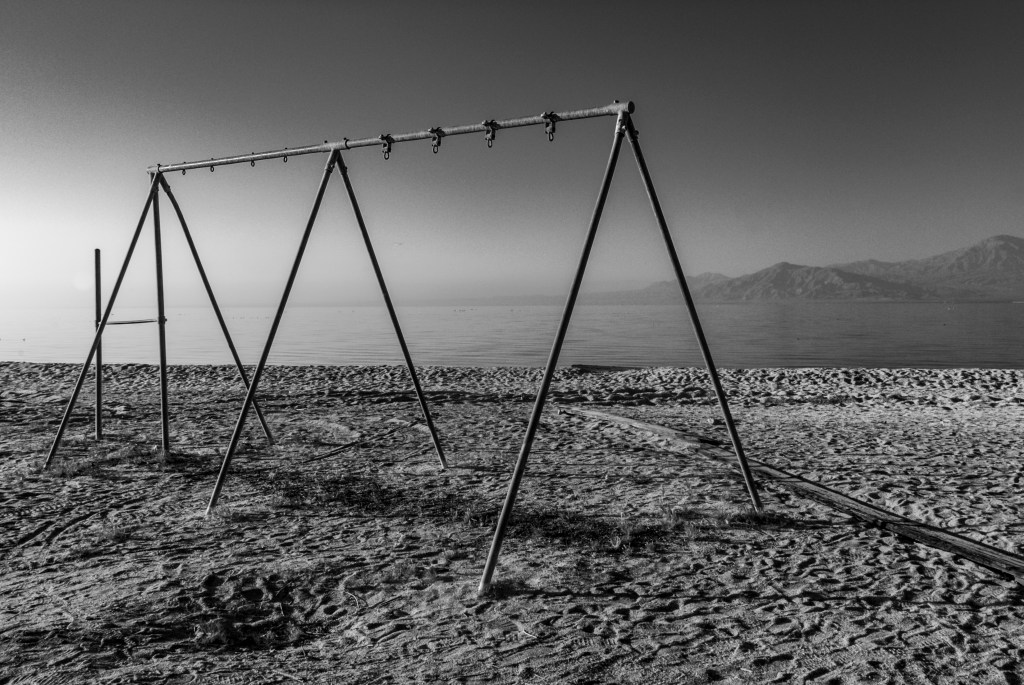
Photo Credit: Steve Zimmerman is a writer and photographer residing in the Pacific Northwest after migrating from the Midwest. His work has been published in the Evansville Review, Montana Mouthful and 3Elements Literary Review, amongst others. More of his work may be found at szimages.photography

