L’Esprit Literary Review
Judged by Michael Nath

I like fiction that banquets the reader. Too much fiction now follows a strict diet.
Michael Nath
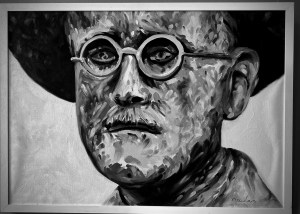
Original portrait of Leopold Bloom drawn by Issue One Contributor Jennifer Ostopovich
L’Esprit seeks short fiction exhibiting exceptional ingenuity and vision in narration, now sponsored by Chill Subs’ Contest Transparency Program.
$500 and publication in the journal awarded to the winner; $200 and publication to Second Place; $100 and publication to Third Place; and $50 to two (2) Finalists. All entries include a digital edition of our next full issue and are considered for publication.
In a short story or novel excerpt of up to 5,000 words, we are searching for risk-adept narration that challenges the conventions of prose and composition. All excerpts must stand on their own. Both first- and third-person work will be considered. Pieces with emotional depth and urgency that take sophisticated narrative risks in terms of both sentence and story will be in the strongest contention. We are drawn above all to voice and style. Surprise us. We look for fiction that accelerates form irrevocably into content.
All entries will receive one free month of any Chill Subs Membership. Additionally, Chill Subs will provide the Grand Prize Winner with 5 years (worth $1000) of Membership. Second and third place will receive 2 years ($400 value), while finalists will receive 1 year ($200 value). These are in addition to the monetary prizes and publication from L’Esprit. See the previous results–and read all five Finalist stories in the 2026 Prize–here.
In the first round of judging, the L’Esprit team will assemble a shortlist–and potentially a longlist–based on technical-mechanical skill, acuity in blending verisimilar narrative elements with robust narrational architecture, and prosody. Longlist announcements will be made on a rolling basis.
At the close of submissions, the L’Esprit Editors will select from the longlist a group of finalists to be sent to the Guest Judge. Shortlist, Finalists, and any Honorable Mentions will be announced permanently on the journal website. All entries will be considered for paid publication in the journal. Our most recent contest received 358 total submissions.
The Grand Prize Winner and Second Place Award will be selected, via blind read, from this pool of finalists by Guest Judge Michael Nath; see more on Michael’s background and interests below. L’Esprit is a proud member of CLMP and abides by the CLMP Contest Code of Ethics.
We have two options for entrance. A $10 fee includes a complimentary digital copy of L’Esprit Issue Nine, featuring writing from David Ryan, Ivana Sajko, Mary Elizabeth Dubois, Marilyn Abildskov, Ursule Molinaro, and more. Issue Nine also features the Grand Prize Winner, Second Place Award, and Finalists from the 2026 Clarissa Dalloway Prize for Short Prose. This high-resolution version is optimized for reading on tablets and other devices, allowing the issue to be experienced as designed, immersive and rich.
A $15 fee includes the digital copy of I9 plus an Expedited Response; we will prioritize your submission and reply with a decision about the longlist phase within three days. This option may be ideal for those who are planning to submit their piece elsewhere and would especially benefit from a quick response. If the fee presents a genuine difficulty, please email us about a waiver.
We accept simultaneous submissions; please let us know right away if a piece has been offered elsewhere. Likewise, multiple submissions are welcome, with an individual submission and payment for each piece.
All proceeds directly help support the journal and pay writers; contests are vital to help us offset costs such as promoting our contributors at AWP, hosting live and virtual reading events, and paying for print copies for each issue. These expenses are never fully covered by contest proceeds–our editors pay for much of the journal’s operating costs out of pocket–but are a significant help. no way impacts the likelihood of publication.
L’Esprit does not discriminate based on the background, education, or identity of those who send work to us. All work is evaluated solely on merit, without regard for any other consideration whatsoever. We encourage those of all backgrounds and experiences to send in their work, and look for writing exploring the range of the human condition.
Please include the following with each submission:
- A third-person bio, to be used as the contributor’s note should your work be accepted.
- Social media handles (Twitter and Instagram), if you’d like to be promoted online.
- An optional cover letter to introduce the work, yourself, provide some context to your submission, or mention how it celebrates narration; please note that this in no way impacts the likelihood of publication.
- Finally, we would appreciate knowing how you found the journal (social, ad listing, database search, reference, etc).
See our complete submission guidelines for more. Submit your work to the contest on Submittable.
Thank you for your support of fearless writing.
Michael Nath is a British author and academic.

His first novel, La Rochelle (2010), was shortlisted for the 2011 James Tait Black Memorial Prize for Fiction. His second, British Story: A Romance (2014), was a Morning Star Book of the Year. It was described by The Times Literary Supplement as “a wonderful exercise in novelistic virtuosity, strange and beautiful.”
His most recent novel, The Treatment, (Quercus, 2020), was a critical success: The Guardian (Michael Donkor: “it is the voices and the language that make this novel such a triumph”); iPaper (Sarah Hughes: “His writing is addictive, sometimes strange, often beautiful”); Arts Desk (“A London novel to join the greats”); Morning Star (Paul Simon: “beautifully vulgar”); Tablet (hailed by AN Wilson: “Some of the most interesting dialogue I’ve read in years … a fantastic book”); Metro (Anthony Cummings: “a maverick project that defies comparison”)
Michael on what he likes in fiction:
I like authors who are doing it their way; their ‘signature against the world’. This is why I admire novels as far apart as Wuthering Heights and Neuromancer: Emily Brontë and William Gibson were making the rules for themselves. This is why I read Moby Dick twice in my first term as an undergrad. And why I keep reading Musil, Kafka, Joyce; Sir Water Scott, Jane Austen, Dostoevsky.
To me, there is nothing more important than voice. What is voice? The most familiar mystery; is there anything more friendly?
Above anyone, I admire Shakespeare: a dramatist, also one of the greatest writers of prose; he indicated the future for the novel in English. The prose of Shakespeare has the vigour of an ever-growing tree; I like prose that is woody, not lapidary: living, not stony.
Listen to Nietzsche: ‘Of prime necessity is life: a style should live.’
And let’s add that Shakespeare was supreme at setting problems, rather than solving them. I like fiction that dives deep, without checking its oxygen.
I like fiction that laughs. When the royal librarian begged Jane Austen to try an historical romance, she wrote back to him that they’d hang her for laughing: ‘I must keep to my own style & go on in my own way.’ Huzza!
And I like fiction that banquets the reader. Too much fiction now follows a strict diet.
I don’t care for fiction in the present tense: we weren’t all born this morning.
And I like fiction that has its way with my heart; Jane Eyre has its way, every time.
An interview with Michael can be found here.
Dan White, Private Collection
in mediam mentem // Leopold Bloom Prize

