Hannah Onstad
Fiction
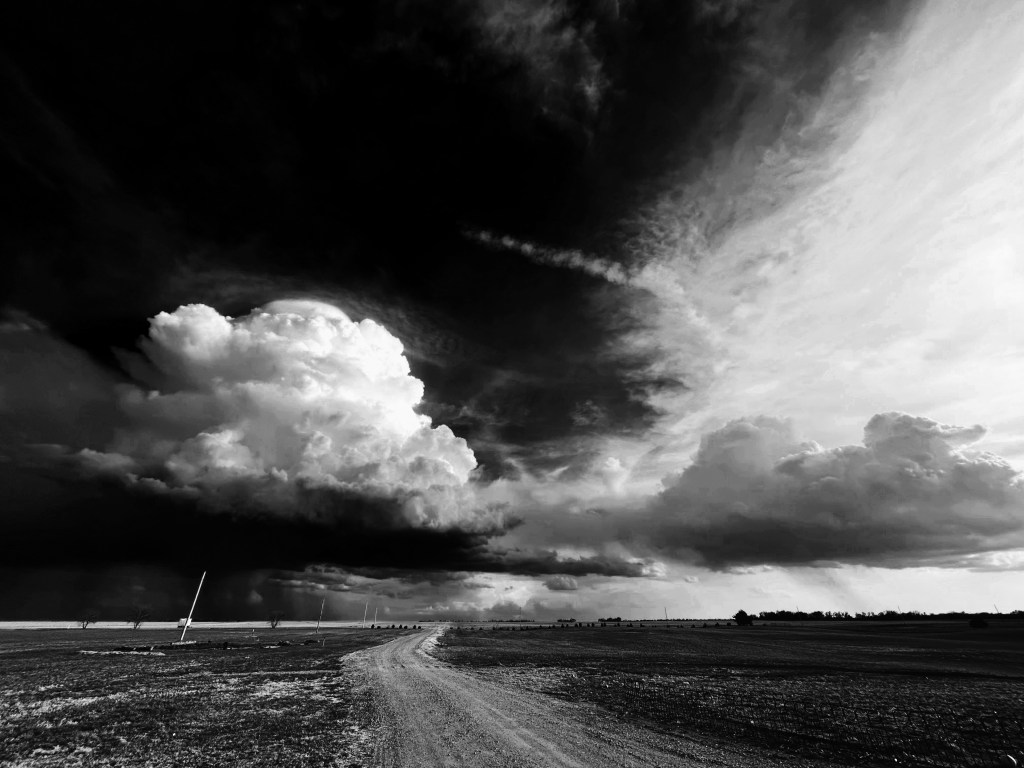
The Road Out of View won first place in the 2026 Leopold Bloom Prize for Innovative Narration, judged by Michael Nath.
Michael’s Comments:
This is a genuine and ambitious exercise in surrealism, dissolving the boundaries of experience, dream and time, via the images of a disappearing desert road, a vintage typewriter, and a white space/gallery whose owners, exhibits and parental visitors return and merge in the general narrative. The impression of ontological flickering, haunting, and transformation is enchanting, and troubling (eg, in the image of Colin’s mother); as is the suggestion that Fan is somehow in charge of what occurs.
The story also manages a kind of spaciousness and extension that I miss in the work of another notable practitioner in the surreal, John Hawkes (The Lime Twig), where the reader often feels unbearably close to the foreground; though I did feel that the whole thing might have paused a little more for its effects to register even more powerfully. I also wondered about the decision to leave direct speech unmarked (though there may be a reason for this pertaining to the status of the world represented here).
A remarkable, and phenomenologically compelling, submission. I might add that it also put me in mind of the ‘Time-Flats’ in another metaphysical fantasy, The Childermass of Wyndham Lewis.
We were driving alone through the desert under the midday sun, when the road we were on flickered in the heat. The road, which had unspooled before us like a long black ribbon, wrinkled and jittered, coming in and out of view. Then we lost sight of it. The road itself disappeared, erased, expunged, redacted. I wet my lips, then rubbed the windshield with my hand, streaking the glass. The road was gone. Waves of heat shivered, floating above the hot sand in the distance.
What’s going on, Fan said. I was relieved it wasn’t just me, Fan saw it too, this wasn’t an illusion.
We must have run off the road, missed a turn, it must be behind us, I said. I looked in the rearview mirror, but saw no road. We hadn’t seen any other cars for a while. I looked over at Fan, she was beautiful when frightened, her eyes wide as headlights, her body tense as a cat’s. I looked down at my foot still on the gas, my worn tennis shoe. The car drove smoothly over the uneven surface. How could that be? It was us, not the road.
It’s OK, I think…It’s just a matter of perception, I said. The road is still there. We’re still on it.
But how? Her voice was insistent.
I had no idea how. Fan was right. This made no sense. I braked. Full stop. We got out. I heard the car door shut. We spun in circles. What we could see of the landscape blurred in the heat haze. I walked to the back of the car. My shoes, her sandals sank into the sand, which reminded me of when we’d tried to walk in the melted asphalt in the Djemaa el-Fnaa years before, the hot sun overhead, our soles sinking.
Have we got any water?
A bit, Fan said. She leaned in the car window and pulled out a shrunken plastic bottle, warped by the heat.
We stood in the emptiness, in the desert. There was no shade. I took a swig and handed it back to her. She shook her head.
I just had some. Are we going to die here, she asked.
No. It’s just the refactoring of light, light bending with the hot air. An optical trick, I said. The road is still here. How else to explain it? We were lost. We’d left the road behind somewhere, and kept driving. For how long? I couldn’t say.
Look, let’s just walk back a bit, find the road we were on, then get the car. The road probably just got covered in a sandstorm. Let’s retrace how we got here.
Without the car? I don’t feel safe, Fan said.
We’ll be fine.
Why leave the car?
So, we can brush some sand away, find the road.
Fan still seemed unconvinced.
I took a few steps away from the car. Though stepping away from my blue 1965 Ford Falcon made me uneasy. I’d bought that car in my early 20s, restored it, and drove it ever since.
I don’t feel safe, Fan said.
C’mon.
I took a few steps away from the car. Though stepping away from my blue 1965 Ford Falcon made me uneasy. Without the road, everything looked the same—desert all around, mountains in the distance. I felt a sense of déjà-vu.
Fan, have we got any water.
I just gave it to you, she said.
The desert unwinds time across space. Our memory of where we were, or how long we’d been there had been altered by space-time.
A creature flew overhead.
We stood still, tracking its formidable, dark imprint across the ground.
What the hell…
Shhh, be quiet, or it will hear you. Her eyes rolled upward. What was it? Turkey vulture? Hawk? Fan seemed unnerved, and tried moving forward. She took a cautious step, then a few more. I joined her. We looked behind us. We left no tracks.
Walking through sand, our steps were clumsy. Beads of sweat slid across my face. I stopped repeatedly to empty my shoes. Fan tapped her sandals on her calves to shake it out. We grew tired. After an hour or so, we tried to chart how far we’d walked. We had no map. It was as if our world was disappearing, bit by bit. But up ahead the sun caught a glimmer of the hood of the ‘65 Ford Falcon and we realized we’d walked in a circle. We made no progress.
Fan reached inside the back seat, and pulled out a vintage Lettera 32. The green-teal, aluminum alloy made a lovely contrast against the earthy tones of sand and rock. She placed it on the trunk. Her fingers immediately sought the smooth indents of the keys, a sheet of paper, still in its platen. She advanced the paper, and the large black rubber roller made its soft clicks. Our conversation slowed. She began typing, pulling spare sheets from a bag in the backseat as she needed them, and squirreling away the sheets she finished.
The sun was disappearing over the mountain. Ripples of soft pinks, pale yellows dissolving over blue. The sun setting was a relief to our skin. Though I knew we’d be cold soon.
Whose story is this? I said and motioned to the typewriter.
It’s ours. I smiled, though it didn’t change our predicament.
Look at the moon, Fan said. It started to appear in the sky, a new moon.
A waning moon, I said.
A waxing one, she said.
Waning.
Honestly. Her voice was drained of love. Yet, it was as if she’d absorbed a certain radiance from the moon, a pale glow, like starlight. That evening, with nothing else to do, we talked. Fan told me her reputation had been ruined by something I had provoked her into doing nearly 14 years before. I had forgotten about the incident until she mentioned it. The incident involved my father. I was surprised that she’d felt so strongly about it, and had been able to keep her feelings to herself. We argued.
After that we grew tired. Her back was beautiful, glowing, and I watched her. The temperature dropped and she reached into her purse. She shook out a fur collar, and placed it around her neck. I wanted to run my hand along the fur, but Fan seemed distant, lost to me. Then she reached into her bag again and took out a cigarette and lit it. Her purse looked small, and hung by a braided strap. It seemed unlikely to hold much of anything but Fan brought clove cigarettes, a typewriter, and fur to the desert and what had I done? I did nothing but make the road disappear. I took responsibility for the road, but her reputation? No, that was not my fault.
Never mind about that. Your reputation wasn’t ruined. That happened a long time ago, I said. It doesn’t matter.
She blew air from her nostrils, two parallel streams of smoke released between us.
You didn’t care then either. You never did. She kicked her toe at the ground.
It did matter, in the same way matter and antimatter can annihilate each other. I wanted to touch her but dared not.
To me, this incident which involved my father was insignificant, not even worth mentioning, especially now. Fan took off her sandals. She rubbed her heels where the straps left marks and peeled her skin. I rolled up the sleeves of my shirt.
You ok?
She glared at me.
The situation felt bleak and I was eager to shift our thinking.
Look, I said, I’ll get us out of here. The road is still here. It has to be. We just have to find it. Her lip twitched. I got down on my hands and knees and circled on all fours, my fingers sifting cold sand, but the sand disappeared as it slipped through my fingers. It seemed like I was erasing whatever I touched.
She inhaled audibly. I detected a tone of frustration.
How could I have thought we shared a vision of the future? I thought we were safe, had cleaved to each other, valued the same things. We’d shared a common language, a visual language, we each understood. We had all the same reference points, mutual friends. Our lives together had been mapped out. Was it my vision, or Fan’s, we were never quite sure. We’d spent time constructing experiences, our own, and those for others. This all took place in the shared white space. Back then, Fan and I were always in the white space—blank walls, polished wood floors, exposed brick. Streams of people moved in and out. We arranged the objects inside the white space for these visitors. Though at times, it felt like Fan and I were the objects on display.
On the day of the incident, my father came to visit me. I was in the middle of hanging a show, a series of oversized prints of animals playing dead in the snow. Framed and larger than life, they were startling; a husky frozen in a snowdrift, eyes closed; a deer gracefully sleeping in the foreground blending into a background of ice, twigs, and leaves; a duck splayed on its back, legs in the air. Fan suggested the artist may have drugged the animals, but no, the artist had assured us that no animals were harmed in the creation of his work. I was about midway through and already exhausted and wanting to wrap up before it got dark.
My father appeared in the doorway, wearing his fleece-lined flannel and his winter boots. He came to ask a favor. He too wanted his time in the white space. I couldn’t refuse.
Fan was trying to light another cigarette. I cupped my hands around hers and the flame brightened between us, then faded.
Let me explain, I said to Fan. She grimaced and blew smoke from the side of her mouth.
Colin, let’s just concentrate on what to do now, ok? She didn’t want to revisit the past.
You brought it up.
I never should have suggested we take this trip.
Fan, this isn’t your fault.
She said, I know.
Still, there was a question of who was responsible for our situation, and I did not trust Fan’s memory anymore. She was blaming my father for her reputation? But what about her? What did or didn’t she do? Fan and I looked at the night sky and her fur vanished. She was a fox denuded in the moonlight.
We should dance.
Fan half-smiled at this.
If I held her, if we closed our eyes and concentrated, perhaps all that was missing might reappear, then we could drive on. I envisioned taking Fan’s hand. She would step closer. I would dip my head until my lips touched her nape. We’d step back-and-forth, avoiding the scorpions which had begun to scutter near our feet.
A single drop landed on the bridge of my nose, the next fell on Fan’s bare shoulder.
I still wanted to dance.
Fan did not. She shook her dark hair when I asked her, and ran her fingers through it. She pulled up her dress and laid down in the middle of the roadless night, while raindrops fell from the sky. A scorpion scampered across her bare stomach. Its segmented tail rose and twitched in the rain.
Get up, Fan.
No, she said.
I raised her sandal overhead as if to strike the gunmetal sheen of the scorpion scurrying into the shadows. The hawk, or whatever it was, returned. It landed in my peripheral vision and stepped closer. Its dark oily wings flapped. The bird swooped and took the scorpion in its beak and took off. That night in the desert, I had a dream in which my father swallowed a scorpion and his throat was on fire. The metasoma metastasized. In the morning, the sun warmed my eyelids. We had fallen asleep in the rain and cold, and were damp, but the sun was out. Sand stuck to Fan’s face. Still, she was lovely. Her lips still had a tinge of color. I shook my fingers across my head to get rid of the sand.
It was a new day. If only Fan knew how much I loved her, she would be patient, not angry. I ached to recover our lost world, to start the Falcon and drive again. What we’d thought was urgent, was not. I closed my eyes. It was as if Fan could read my thoughts. She leaned over. Fan gave me the softest, most delicate kiss, like the flutter of moth wings. My breath left my body in waves.
It didn’t work. We couldn’t agree about what to do next. Fan and I did leave the desert, the only way possible. Once we decided we would part, and walk away separately, we set out. We tried to forget everything that had happened between us. We went in different directions and I was surprised when a different, unexpected road appeared. I went back, no sign of Fan, we had stopped speaking, I decided to take the Falcon. I left her Lettera 32, her papers, and her bag right there in the desert, and took off. I often wondered what had happened to her. But Fan had a way of always getting herself where she needed to go. Did I think it was possible she could have died there? Yes, it was possible, but I trusted her cunning, her beauty. A year later, I read a story in The New Yorker, about a couple in the desert. It was written by someone else, a pseudonym, I thought. I knew from the details, the Falcon, the hawk, she’d found her way back to her typewriter, to her work, and she’d found a way out.
A decade passed, then, she called. It was a July afternoon, and I was standing on the terrace, I was watering my potted plums which were fruiting. After my initial surprise, the grooves in our conversation became strangely familiar. I’d forgotten how well we knew each other, had all the same points of references, inside jokes, people in common — it felt as if no time had passed. We found ourselves laughing, me on my terrace holding the phone, and her out in her ranch house in the desert. Then, she said:
But you know, your father should never have asked a favor of you. Why didn’t he ask me directly?
Oh no. How many more times would we go through this?
If your father had asked me, I would’ve said no, she went on. I would have told him directly, he could not have a show again. Not then, not so soon. Maybe not ever.
I laughed. Fan, don’t you think he knew that? That’s why he asked me, not you.
A few nights after the phone call from Fan, I was inside my bedroom getting ready to go out, when my mother appeared. I was confused. You’ve been gone. What are you doing here? She said she was readying the space for her exhibit. She would install her paintings herself. She’d cover the walls with her sorrow. Icy blue canvases, objects floating in air—a locket, a mirror with an ape’s reflection, a compass, the sky with ochre-colored cracks, white crystals, ice caps. Cold washed over me as we looked at them. It had been six years since she’d passed.
I finally found the time to work on my art, my mother said. She wanted her show.
I have to ask Fan if that would be all right, I said. Who knows what made me say that? Habit, I suppose. This enraged the circle of wind who was my mother. A vortex formed.
Then my father was there and he was angry. I’m going too, my father said. His voice sounded hoarse.
I will walk you through the Djemaa el-Fnaa, I promised. I was feeling ill. I went out to the terrace again and looked down onto the street. There was a line of traffic snaking through the city.
Fan appeared too. How will you find the Djemaa el-Fnaa again, she said. That’s just another promise you cannot keep.
I sat down in the circle of wind. Fan put her sandals back on.
I’m going too, she said. She would walk my father there herself.
We were all in the desert.
Fan shielded her eyes from the heat, resting her palms on her cheeks, her fingertips on her brow, creating a dark cave, giving her eyes a rest. The wind played with the hem of her dress. She turned to my mother.
Tell me about your paintings, why are they filled with sadness?
I will show you, my mother said. Fan and my mother merged.
I was unhappy for seven years. You never noticed.
That is a lie, I said. It was the last thing Fan ever said to me. It was the last thing I said to her. Perhaps, she was right. I had to move further back in time, to reconsider what had occurred. I constructed my own map. I placed on it all the points of reference, I surveyed everything, a perlustration.
In the Djemaa el-Fnaa, I saw the arch, the courtyard. A man tamed scorpions, another swallowed fire. I saw another man with a bicycle and a cart, selling orange juice. Where was Fan now? The earth buckled. The ground beneath us refused to stay flat. We were there in the desert. An assembly of the dead. All of us wanted, and did not want to be there.
Is this what you wanted, I whispered to my father. He nodded for me to look up ahead. Fan was moving out of the square, extinguishing herself. I watched her go. I wept for all we would not see. The desert at night. Falconry. Firewalking. All the objects from the white space that had disappeared.
Fan loved those objects more than us. She’d asked me to move objects out of the white space. It was always subtraction.
Wasn’t that the real problem, Fan? Not what my father wanted? Fan had made room in the white space for what she wanted. Arranging and rearranging. Nothing that she did not want was there. But what about us? All of us?
My mother flickered and disappeared again, then my father followed. Fan floated like dust across the desert floor. She circled me once, I know she did, and rose in an arc and before I could say another word, she vanished in the sky. I stood for a long while looking out over the lights of the city, unable to move. Then, out of the corner of my eye, as I looked down, before I could fully see it, I sensed it, another road appeared.
H. L. Onstad’s writing has appeared in ZYZZYVA, Harvard Review, Kirkus Reviews, Solstice Literary Magazine, Simpsonistas, Vol. 6 (Rare Bird, 2024) and Vol. 7 (Rare Bird, 2025), and HA Journal: a publication of the Hannah Arendt Center for Politics and Humanities at Bard College.
Photo Credit: Parker Holliday is a photographer and poet based in Oregon, United States. Her work often uses nature to explore the ways we break and the ways we keep going.

