Andrea Lewis
Fiction
From Denver south to the New Mexico state line, I drove through one thunderstorm after another. Hailstones drummed the roof and ricocheted off the windshield for a blinding mile or two. Then, as if a switch had been thrown, a stretch of dry road and blazing sun opened up like the entrance to a new world. Moments later, another wall of black water pulled the car into the next downpour, flooding the high-speed wipers. The pattern repeated for almost five hundred miles. Each wall of water felt like another obstacle to getting the hell out of Denver and starting over.
—–
And then we were in the dark tunnel of the cloakroom, plunging from the bright classroom into a black wall of turbulence, desire so thick it slowed the turning of the earth. I had never done anything wild, but here was the clarity of danger, everything distinct—the smells of orange peel and pencil shavings, the distant shouts, kids on the playground, light creeping in from either end of the cloakroom and landing on a Flintstones lunchpail, a pair of yellow rubber boots. Ron Apodaca, all chalk dust and Dial soap, his tongue in my mouth, his hand gathering the hem of my skirt. My own hands, wanting any part of him, touching the sides of his head, his glasses still in place, his ears hot, then his back, his belt buckle, but I was shaking and useless. He did the work, the clothing and the underwear, the obstacles, while I stared over his shoulder at Alice Mondragon’s red cardigan hanging there in the half-light. If Alice had appeared in the flesh, we could not have stopped our muffled groans, our comic maneuvers as Ron Apodaca clutched my hips, as I wrapped my legs around him, as I bit a mouthful of his white shirt to keep from growling like an animal.
—–
The terror that was Parent-Teacher Night arrived mid-September, before I’d barely settled in. I piled on Mitchell’s anti-perspirant and Max Factor make-up, but nothing prepared me for meeting Alice Mondragon’s father, a half-bald, barrel-chested rancher in a white nylon shirt and silver bear-claw bolo tie. He introduced himself by saying, “I wanted Alice to have Mr. Apodaca for fourth grade.” At least he said it out loud. Other parents simply looked worried or told me how lucky I was to have Mr. Apodaca in the classroom right next door. Alice’s father looked me up and down, eyed my wild, untamable hair and my wild untamable breasts—which I had tried to squash behind a navy-blue blazer—and the red heels that matched my red skirt.
“You’re awfully young,” he said. He let his gaze drift around the room. Where Ron Apodaca, right next door, had walls covered in inspirational posters (Albert Einstein, Hank Aaron), a terrarium with tiny cacti and a horned lizard, a vast depiction of the solar system, and a photo collage of fourth graders in Africa, I had some yellow and brown cut-outs of fall leaves and a record player. Mr. Mondragon’s eyes rested there. “Is that for the folk dancing?” he asked.
—–
My new job—my first real job of any kind—was teaching fourth grade at Socorro Elementary in Socorro, New Mexico. I took the meaning of Socorro, Spanish for help or aid, as a hopeful omen. I was twenty-five, escaping Denver, flattened like roadkill by a break-up with the man—Connor—I thought I would marry. He pulled up stakes for the Peace Corps, a TWA ticket for Dakar, Senegal, already in his pocket when he asked for the ring back. I had a bachelor’s degree, a teaching certificate, a scant semester as a classroom assistant, and no idea what I was doing. The prospect of facing a roomful of kids armed with the dull curriculum supplied by the district made me feel as useless as my windshield wipers had been in the thunderstorms. But I needed a job and was determined to hang onto it.
—–
In the dissolving stillness that follows lovemaking, I heard echoes of our thuds against the hollow wall of the cloakroom. Still on my tongue was the iron-and-starch taste of Ron’s shirt. I smoothed the damp shoulder seam and apologized. “There’s lipstick,” I said. “Will anyone see it?”
“You mean am I married?”
I waited. He didn’t wear a ring, but I had never been certain.
“I’m boring,” he said, kissing my neck. “She left me.”
—–
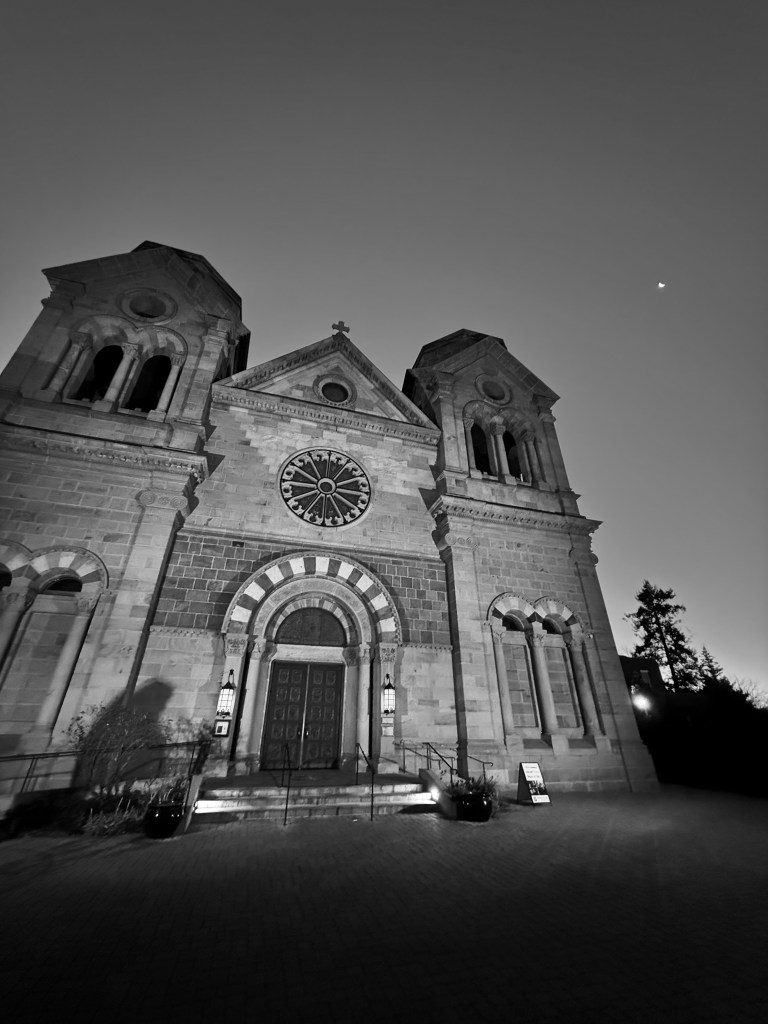
The thunderstorms ended before I arrived in Socorro, with its tired elm trees, its four-hundred-year-old San Miguel Church, its town plaza and one movie theatre—marquee advertising M*A*S*H*—and its haphazard, fanned-out residential streets and cul-de-sacs. I had rented a furnished apartment, sight unseen, in a complex called Escondida, another omen translating as hidden. The building looked like a sideways box of saltines, baking in the sun. While I waited for the landlord to arrive with the key, a cicada chorus droned from a dying Dutch elm that grew out of a gash in the asphalt parking lot.
—–
At Teachers’ Orientation, the relentless New Mexico sun threw parallelograms of light across the cafeteria tables and halfway up the walls, where banners welcomed us to the 1970-71 school year. My back throbbed from my first night on the fold-out bed in my apartment. That morning, I had hauled in groceries and unpacked books and clothes and a few dishes. When I saw mouse droppings at the back of a kitchen cabinet, I sat on the floor and cried.
One of the parallelograms framed Ron Apodaca—I did not yet know his name—where he sat on the dais with our principal Ada Garcia and a bureaucrat from the district, a man simultaneously huge and invisible. Ron Apodaca was slim and serene in his starched white shirt and dark slacks, his heavy, black-framed glasses and black hair tinged silver at the temples. He generated his own atmosphere of calm, separate from the spiky energy of the overlit room. While the other teachers shuffled papers or scribbled notes or looked at their watches, while the invisible district man droned on about pride in our work and molding young minds, while Ada Garcia’s hawk-eyed gaze flitted over the tables, sizing up her staff, Ron Apodaca appeared self-contained and a little bemused. Then his name was spoken, and he stood up.
Ada Garcia presented him with a Twenty-Year Award, heaping praise upon him: the most beloved teacher in the Socorro County School District, revered for his uncanny ability to connect with students. Every fourth grader, from the most overactive hellion to the most frightened introvert would thrive in Ron Apodaca’s classroom. Whether they were agog over a potato clock or making a mess with a baking-soda volcano, he always corralled the chaos and drove home the lesson. For his part, Ron Apodaca looked on impassively during this salvo of veneration and declined to give a speech after receiving an ugly plaque. I sat in my own hot parallelogram, breathing in the sweet purple scent of mimeograph ink from our many hand-outs. As the only other fourth-grade teacher at Socorro Elementary, I wondered just how bad I would look next to this paragon of virtue and experience.
But he was good to me. On the first day of school, my students,pouncing on my uncertainty like a pride of lions on a lame wildebeest,had gone feral by ten a.m. Sensing the chaos from next door, Ron Apodaca strolled in, and, before he uttered a word, the whole room settled into eerie quiet. Such was the preternatural command he had over a roomful of kids. True, they knew him by reputation, but it was more than that. It was a force he exerted, like magnetism or gravity.
“Everybody settling in?” he asked, eyebrows raised, curious glance about the room. The kids sat dumbstruck, unsure about how much trouble they were in.
“We’re doing great,” I said, shooting him a weak smile of gratitude.
—–
I could see right away that Alice Mondragon would develop a crush on me. She was a skinny kid, stick legs and plaid dresses with ties at the back. She could be nervous and shy, then suddenly coy and cunning. She had fly-away hair, so blonde it was white, with staticky strands escaping her ponytail in the dry desert air. Her slightly protuberant eyes blazed dark blue and her white ankle socks were always slipping low on her heels into her Buster Brown shoes. She often stayed late, wanting to help me or asking personal questions: Why did I always wear high heels? Why was my purse so big? Where did I live? Was I married? What color lipstick is that?
—–
“Were you this hopeless when you started?” I asked. We were two weeks in, and Ron Apodaca came to my classroom every day after school. He gave it the air of a casual debrief, but I hung on every word, desperate for his help. I tried to be professional, ask the right questions, and learn from him, all while wanting to clasp him about the knees and plead How do I do any of this? That afternoon, he found me crying at my desk. I had done nothing all day but call for quiet, threaten punishment, and tell kids to sit down. Like a broken record, I kept asking them to open their workbooks to an exercise even I knew was boring. But I kept forcing it on them, and they kept finding excuses, passing notes, stabbing each other with rulers, making fart noises, and asking to go to the bathroom.
Ron laughed. “Oh, I was a mess when I started.”
I did not believe him. I pictured him emerging from the womb with his glasses intact and his talent for teaching already obvious.
He rested his hand on my shoulder. “You’ll get there,” he said. I wanted to take his hand and kiss it, as if he were Jesus or the pope, as if he could lift me up with a blessing or a miracle. I was already in love with him, the way his slight build and modesty belied his depth and substance. He made my ex-boyfriend Connor look shallow and mean. In my waking hours on the torture-rack of the fold-out bed, I no longer pictured getting Connor back. I pictured escaping Socorro with Ron, ending up as lovers somewhere exotic. But I needed a mentor more than a lover. Or so I told myself, until his hand on my shoulder made the slightest movement. One finger traced a tiny line along my neck, and that became the afternoon of the cloakroom. There in the gloom was Alice’s red sweater. There was the Flintstones lunchbox. And there, inside me, was the man who introduced me to myself.
—–
Principal Ada Garcia left the venetian blinds up in her office so the afternoon sun stabbed my eyes when I sat across from her. Squinting, I tried to read her face. She looked angry, but she always looked angry, her hair in a tight bun and her mouth in a tight line. I was trembling. In the week since the cloakroom, I worried that someone had heard us or seen us or reported us. She folded her hands, prayer-like, on her desk and said, “We’ve had a complaint from Alice Mondragon’s father.”
“A complaint?” I tried to sound concerned rather than relieved. Rather than gloriously happy. If she hadn’t heard about the cloakroom by now, she probably never would.
“He said you let Alice put on lipstick. Your lipstick.” Ada Garcia, I was certain, never used lipstick, but she was wearing a silver and turquoise Navajo squash-blossom necklace that spread across her chest like armor.
“That’s true,” I said. No reason to deny it—I was willing to be embroiled in any controversy that did not involve Ron Apodaca. “Alice asked me about my lipstick color. It’s called Pink-a-Boo, and that made her laugh. I guess we got a little carried away.” Put some on me, Alice had demanded. I don’t know why I did except that I saw a hunger in her that I remembered as a child, a desperation to crash the gate at the next level of womanhood, to feel desirable, even without knowing that word or understanding that impulse.
“Emilio Mondragon has power in this community,” Ada Garcia said, fingering the necklace. She enjoyed showing off her insider status. I didn’t know the right people, wear the right jewelry, or even know how to defy the demands of a skinny fourth grader. “Don’t let it happen again,” she said.
—–
Crazed sex in a cloakroom began to feel wholesome compared to the sneaky tryst we planned a few weeks later at the Sundowner Motel in Albuquerque. Like small-time crooks, we left Socorro in separate cars, at different times. The plan was to meet at The Stack, a pancake restaurant near the motel. It was a beautiful Saturday morning in October. Brown hills against a sapphire sky. Clouds so white, puffy, and perfectly placed that a fourth grader might have drawn them. I drove too fast up Highway 85, racing toward an affair that could get me fired. I doubted Ron would get fired. Not Mr. 20-Year-Plaque-Perfect-Teacher, whom they needed much more than they needed me. He would be forgiven, bewitched as he was by the terrible teacher from Denver, tempting him in his loneliness with her high-heel shoes, clingy sweaters and Pink-a-Boo lipstick.
I found Ron sitting alone in The Stack, a place with orange and brown commercial carpeting, six-syrup carousels on every table, and the interlaced aromas of burner coffee and bacon grease. I had never seen him outside of Socorro Elementary. Amid the brown paper napkins and pink sugar packets, he was less god-like. And I suspected I was less desirable. We ordered breakfast and made small talk, but I sensed we were both weighing the cost/benefit of the entire enterprise. The cost of breaking the erotic tension that had built up since the cloakroom versus the benefit of some predictable, missionary-position orgasm in an ugly motel room in Albuquerque. Abstinence suddenly felt more exciting and less risky than the reality of unlocking a hollow door at a motel and rolling back an unwashed bedspread. I busied myself with boysenberry syrup and foil-wrapped butter and bolted my two-egg, short-stack special like an inmate in a prison cafeteria.
—–
The Monday after the Sundowner, I was again called to Ada Garcia’s office, but instead of the principal sitting at her desk it was the large invisible man from the district. Again the sun was in my eyes, the room was hot, and Mr. District had removed his jacket and loosened his tie. He looked like a sweaty TV cop ready to pounce on a perp. He had a file folder in front of him with my name on it. I braced myself. Had someone seen us in Albuquerque?
He rested his stubby fingers on the folder. “I’m afraid there’s been more trouble with Emilio Mondragon,” he said.
“What did he do now?” I asked.
“I wouldn’t joke if I were you.” He drew his invisible eyebrows together. “He’s calling for your removal.”
This stopped my breath. I didn’t understand. Alice was doing well. She still hung around me a little too often. If I had playground duty, she might take my hand during recess, as if she’d rather be with me than her friends. Or she’d offer to stay late, clean erasers, empty the pencil sharpener. But she was a good student, probably the smartest in my class.
“Mr. Mondragon feels that your classroom fosters an atmosphere of permissiveness. Dancing and so forth. Some of it rather lewd.”
Folk dancing was reserved for Friday afternoons, when the kids were too bonkers to do anything else. I often skipped the learn about other cultures part, although I did mention that The Chicken Dance (“Der Ententanz” or Duck Dance) came from Switzerland. There was more, but nobody was listening. I put on a record from the district library––a dusty 78-rpm from a bulky album of folk-dance music with a sad farm scene on its cover. The silly movements of The Chicken Dance, which sped up with each round, involved making a beak with your fingers, flapping your elbow wings, clapping your hands, and shaking your tailfeathers. Apparently, Alice Mondragon had gone home and given her parents a proud demonstration of her ability to wiggle her butt. She told her father I had demonstrated the move, adding, “She’s really good at it.”
“You’re firing me for folk-dancing?” I tried to shield my eyes to see if he was serious. He could see my hand shaking.
Relishing his power to grant a stay of execution, he said, “Let’s call it a warning.”
—–
As it turned out, the opportunities for exploration provided by our hours at the Sundowner Motel were worth the risk. Admittedly, my experience was limited to two years with Connor and a couple of misguided fumbles before that, but I had never known as fine a lover as Ron Apodaca. Despite the surroundings—the framed prints of fuchsia sunsets looming over the bed, the caved-in mattress with its over-bleached sheets, the wailing police sirens on Albuquerque’s Central Avenue—he did not resort to predictable positions or let’s-make-this-quick shortcuts. He joked that I was wearing him out when in fact he was more energized than I was. But as the day grew late, I grew nervous. Worried about his twenty-year career. Wanting to ask what would happen if the school found out. Wanting to ask where it was all going. But not wanting to break the spell of feeling loved. I drove home through the twilight, wondering if we were at the beginning or the end.
—–
It was late October, and Alice Mondragon hung back after school to help me with Halloween decorations. She didn’t say much as we pinned our pumpkin drawings and ghost cut-outs to the bulletin board. When I told her she could go home, she instead stopped at my desk and checked each pencil in my pencil jar for sharpness. If one didn’t meet her approval, she ran it through the sharpener, inspected the new point, and blew on it softly. Then, as if it had just occurred to her, she asked, “What’s it like to kiss a boy?”
Because of Alice, I had suspended folk dancing and switched to clear lip gloss. I went even further and bought new, ugly shoes with low heels and new, baggy tops with ugly collars. I asked Ron for help with livening up my curriculum. I wanted to keep my job, but I also wanted late afternoons with him, our heads bent over lesson plans, our shoulders touching. Half of me longed to be a teacher as perfect as Ron Apodaca, and half of me longed to return to the beautifully sleazy Sundowner Motel. Neither half wanted to answer Alice’s question.
—–
The third time I was summoned to Ada Garcia’s office, she sat at her desk, and Mr. District hunched like a hippo by the windowsill. This time, the blinds were drawn, and the room was semi-dark, as if to conceal dirty secrets.
Ada Garcia didn’t bother with small talk. “Someone reported that Alice Mondragon kissed a boy in the cloakroom,” she said.
What’s it like to kiss a boy? How long had it been since Alice asked me that? Halloween had come and gone. At least three weeks had passed.
“That sounds like made-up playground stuff.” I sounded defiant, but a hot bloom of fear spread through my chest. “Who is this someone?”
“It was a classmate,” Mr. District said. “And the term making out was used.” He pronounced it as if the term had been fucking or first degree murder. “Naturally, it got back to her father, and Alice told him that you said it would be all right.”
“I did not say that.”
The two of them looked at each other, and Mr. District shook his head, grim in his righteous responsibility to pronounce my sentence.
—–
The sky was silver slate on the late November day I left Socorro and headed north. The snow didn’t start until I reached Raton, near the Colorado border. It continued in a steady down-drift of puff-ball flakes all the way to Denver. The wipers left frozen arcs across the windshield. I peered through them until forced to pull over and scrape them off. My car’s defroster, like so much of my life, was defective.
After Alice asked her question, I tried to buy time. “To kiss a boy?” I repeated. She stood across from me, looking down, fidgeting, twirling a freshly sharpened #2 pencil over the pocked woodgrain of my desktop. “That’s for when you’re older,” I said, hating the cop-out, remembering again what it was like at her age to crave information about the mysteries ahead.
“I know.” Alice nodded. She looked me briefly in the eye, as if gauging if she’d ever get the truth. “But is it fun?”
“Alice.” I pictured Emilio Mondragon bursting in and dragging her from the room.
“Yes or no?” she demanded. That tone, she had learned, worked well with the lipstick. Put some on me.
“Have you talked to your mom about this?” Not ten feet from us was the cloakroom where, among other things, I had kissed Ron Apodaca. Was it fun?
Alice bounced the pencil on its pink eraser. “My mom?” She treated me to an elaborate eyeroll and pointed the pencil at me. “Stop having nasty thoughts,” she said in a foreign voice, presumably her mother’s, “and go clean the bathroom.” She went back to bouncing the pencil and waited.
At the Sundowner Motel, as soon as Ron closed the hollow door behind us, he kissed me. It was a memorable kiss. It didn’t promise too much or linger very long. It managed to be affectionate, sexy, and chaste all at once. It made my chest hurt with joy, and I would have happily stood there motionless for a while, planning the rest of my life around it.
“Yes, it’s fun,” I told Alice. I could not peer into her questioning eyes, the white showing all around the blue, and equivocate any further. “It’s a lot of fun.”
She placed the pencil back in the jar, went to the cloakroom and retrieved her red sweater, and left.
In Trinidad, Colorado, I stopped for gas. When I returned to the highway, the snowfall was even heavier. I drew up close behind an eighteen-wheeler and used his tracks as a guide on the all-white road. For two hundred miles, all the way to Denver, I stayed locked in his slipstream, where it seemed not to be snowing at all.
Andrea Lewis’s stories, essays, and flash fiction have appeared in many on-line and print journals including Prairie Schooner, Raleigh Review, and Tahoma Literary Review. Her collection of linked stories, What My Last Man Did, won the Blue Light Books Prize for fiction and was published by Indiana University Press. She lives in Seattle, WA.
Photo Credit: D. W. White

