Yara Zgheib
Novel Extract
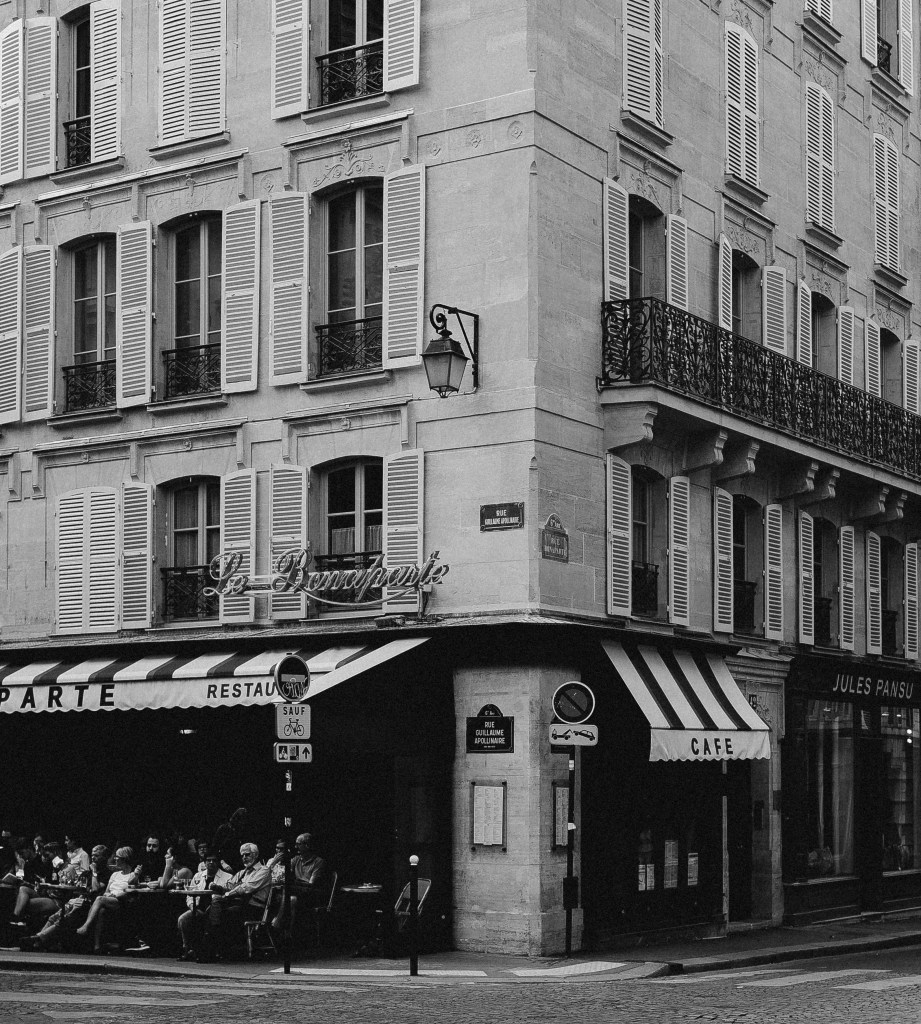
An excerpt of novelist Yara Zgheib’s latest project, Why Paris
There is a place where people go when they are hungry for something sweet. A taste of love and life that’s simple, a place where breathing is easy. It could be anywhere. A room. A country. A bench on a sidewalk, the corner of a street, lined with trees and white buildings and a chocolate shop perhaps. Just a beautiful place.
A place where things might be different. Who knows, maybe better.
There is a chocolate shop in Paris. It is on an elegant street, with trees, in a building cut in blocks of cream Lutetian limestone. Three stories high — nearly all the buildings are on that street— with steep, sloping blue-grey roofs, that Paris-grey that isn’t grey. The zinc casts off the light in tinted shades of silver and lilac, spilling down the building silently to pool in front of the shop on the sidewalk.
It is a quiet street. Wide and clean, with polished brass on the grand oak doors, red geraniums outside the tall windows. White orchids you can glimpse inside. On the mantelpieces and dining room tables of the people, those who live here; you can see them; when it’s cold, they light the rooms early. You see them at nightfall, the lamps on the windowsills, the people cooking and eating and living together and helping each other with the plates. They buy their bread from the bakery on rue de Lévis, their flowers from one of the two warring florists on rue Jouffroy d’Abbans, and their chocolates from that shop on that street.
There are 342 chocolate shops in Paris, scattered along nearly 6,000 streets walked by millions of people every day. This place is small, with a pale green awning, pistachio-ice-cream green, and the name written on, in fine gold letters. The window has a thin gold trim around the frame. Inside, there are bowls and trays, in glass and silver, containing chocolates: bonbons, truffles, bars; candies and cakes. In intricate little boxes tied with gold ribbons; nuts and berries enrobed in silken layers of milk and dark chocolate; marshmallows, candied orange peel, and glittering candied apricots, impossibly thin wafers, and other things: cakes, tarts, breads, jams and jellies, thick, rich, spreads and jars of amber honey, cocoa, coffees, and teas. They catch the light and disperse it on the glass, where it dances and glints, stopping some people passing by. They look in. There’s more inside. The shop is open.
Every day from nine to seven, except Sunday—and August, and some other occasions; birthdays, anniversaries, holidays…but even on those, they’re open for at least a few hours in the morning, for last-minute pickups and deliveries. There’s always someone walking in, at all hours. Everyone is welcome.
It starts at nine. Sharp. With the little old ladies already at the door, in their mink and orthopedic shoes, wearing white pearls and red lipstick, here to buy bags of dainty nougatines for loud little dogs too delicate for leashes—just the small bag, they’ll be back tomorrow— and some Joconde biscuits for the journey home, at the end of the street, to be shared as they walk and stop, walk and stop together; one for the lady, one for the dog; leaving a sweet-scented trail of almond dusting.
Then the day picks up and rushes, the door constantly swinging open with new and old faces entering to buy boxes of four, or eight, or a dozen chocolates, or just one or two; the young mothers with prams, the retirees; those who come at noon or one o’clock, escaping jobs and walls for a quick—something, a je-ne-sais-quoi, leaning over the glass counter. Then at four, the real children, cavalcading down the street with their coats open and flying, set loose from the school on rue Ampère, plastering their faces and palms on the window, making life decisions. L’heure du goûter. The lucky ones have coins, but they all stand and point and speculate, debate and change their minds. Chocolate marshmallow bears? Bonbons? Brittles? Choco-biscuits fourrés? There are chocolate coins too. The children use all their powers—sight and smell, and memories, real or imagined—to create a vision, an actual taste, of single bites of sweetness melting richly in their mouths, as early as tomorrow perhaps. Maybe tomorrow they’ll have real money. Almost as real as if tomorrow were here. They walk away, leaving rabbit-like prints on the glass, and the colors all the way down the street are heightened and luminous. Tomorrow. They run home. Maybe tomorrow will come faster.
Then in the evening, as early as five, the lovers. Always lovers, even those who are alone. Or come in looking lost, like they’d simply been wandering for hours—a happy air of lostness, runny noses, flushed cheeks—and had looked in and realized they were exhausted. Famished. And here is a shop. They enter, enchanted, as if every random turn and all those lost steps could only have ended here, in this chocolate shop that was placed just there. They buy truffles, all the lovers. Not many. Just one or two, enough for one, or two: rich and dense and bitter and sweet, overwhelmingly, at the same time, buttery and with that dusty, almost unbearably pure cacao, melting and coating the tongue, filling every sense.
It even gets in your nose. Everything smells of chocolate after, for a while.
Then at the end, finally, the very end just before closing, at seven. The shop never closes at seven exactly. A few minutes before, just when the person hired to help behind the counter should start locking up the till and vitrines, that’s when they enter, hesitant, those who are truly alone. They aren’t overbearing; they look around quickly and quietly, and before heading out, also buy truffles, for courage maybe.
Yara Zgheib is the author of the critically acclaimed novel No Land to Light On, which was longlisted for the Dylan Thomas Prize; selected as a 2022 Indie Book Read; and chosen by The Washington Post, The L.A. Times, and Newsweek as one of the top books of 2022. Her debut novel, The Girls at 17 Swann Street, was a People pick for Best New Books; a Barnes and Noble pick for Best Books of 2019; and a BookMovement Group Read. Her new novel, Why Paris, and her essay collection Glints, and Other Ephemera are forthcoming. She was born in Beirut and lives in Paris.
Photo Credit: Matteus Silva on Unsplash.
 L'Esprit Literary Review
3 responses to “Why Paris”
How comforting and necessary! Looking very much forward to the better things in life, especially now that our world, my world is shattering!
LikeLiked by 1 person
Reading this felt like stepping into that little chocolate shop — where every word was a bonbon, every sentence a truffle. I’m leaving with my heart a little sweeter and a little fuller.
LikeLiked by 1 person
Chocolate is a serious affair. I lived in Geneva and visited almost daily for my fix. You could write an ode to these chocolatiers who fashion their art by hand. This is not Nestles BS. This is life!
LikeLike