Barthes, Foucault, Eliot, and ‘I’
Jessica Denzer
Editoral Meditation

This essay is the first installment of “How Not To Write,” an ongoing series exploring the intersection of writing, the writer, and the world.
An Editorial Meditation in (probably) Four Parts
by Jessica Denzer
“I think we are in rats’ alley/ Where the dead men lost their bones./‘What is that noise?’/The wind under the door./‘What is that noise now? What is the wind doing?’/Nothing again nothing./‘Do/‘You know nothing? Do you see nothing? Do you remember/‘Nothing?’/I remember.”
T.S. Eliot, The Waste Land
April is the cruelest month. I think it is cruel because it is gray and rainy. My husband reminds me that April showers bring May flowers, as if this was an unknown but important piece of wisdom.
It is true, I suppose, that the showers do bring the flowers; that early spring is a soaking wet period of gestation, flooded with nature’s amniotic fluids, rushing down the gutters of New York, over the glistening trash and sopping dog shit until it flows into the sewers below. I guess that’s just another way of saying the same thing. The rain brings the flowers. Cruelly. Grayly. Painfully.
I am at the Met Cloisters with my husband and his nine-year-old son. We move through the medieval works that are housed there; Rockefeller’s menagerie of architectural bones, shipped across the Atlantic and puzzled together for our enjoyment.1 I stare at the six-hundred-year-old stained glass that remains more vibrant than time, or place, or anything that I have ever seen. It withstands the horrors of humanity with flamboyant defiance. My husband’s son does not care. He asks if we can play hide and seek–this is a castle after all, full of castle things, and so a perfect place to play hide and seek. No, we say. We cannot play hide and seek.
“Why?”
“Because” my husband says, “there are ghosts here, and they will catch you.” We point to a reddish stain on a wall in the interior courtyard. Rust, iron in stone, age upon age. “Blood!” we say. “Look!” The child is somewhat amused. This is enough to get him through most of the exhibits, though we consistently have to hold his hands back, keep him from touching and grabbing the artifacts.
“You will awaken the ghosts,” we tell him. A part of me believes this is true.
When we get to the garden, the gray sky amplifies the bright flowers. The contrast is a bit overwhelming, a bit much, reds and blues and purples and yellows against the dark threatening sky. More rain. And as failures of this spring season, we live in constant hope for something we thought was promised; we of course didn’t bring umbrellas. My husband points to a sign: POISONOUS PLANT. DO NOT TOUCH. A small arm reaches out, almost there, grasping at the leaves. READY. WILLING. We stop him. He claims he would have survived. That he is immune. Something about magic. I can’t remember entirely.
“Funny,” I say to my husband, quietly, thoughtfully, but also amazed. Perhaps this is an epiphany. A sudden insight into what it means to live. To see. “Funny,” I say, “the impulse towards destruction. In the body of a nine-year-old boy, it is all grabbing and touching, pulling and pushing. It is all destruction.”
Children are all Id. Freud will tell you. Just impulse after impulse. We beat it out of them. We hold their hands back. We tell them they have to learn how to live in society. We tell my husband’s child that he must think of other people. Think about how other people feel. We tell him that thinking about other people is a necessary step to being good. And perhaps it is true. I think it’s true, and I hope it’s true. There are so many rules about what it means to be good. So many different definitions: wear this, don’t wear that, drink this, don’t drink that, be this way not that way. GOD IS WATCHING. But is God watching? If there is a god, if the Divine is hovering above, do they have binoculars zoomed in on us? Are they paying attention to what I’m eating? How does God feel about the chocolate bar I just ate for breakfast?
Think of other people.
Don’t destroy.
But that impulse. That impulse for destruction. It is never gone. It is a part of us. Innate, inherent, there, alive. Freud claims that we cannot completely repress the Id. That it lurks just below the surface, bubbling like a slow boiling stew, spilling over the sides in cyclical patterns, sinister desires.
We are all a bit sinister, I suppose. We all have the capacity to kill. We don’t even need any tools if we’re strong. Just hands are enough. Gregor Samsa’s father does it easily. His son is a bug after all, a disgusting beetle, the epitome of filth. He throws the apple hard enough to lodge in Samsa’s back. Does it matter that he’s wearing his porter’s uniform? Does it matter that he’s just doing his job? And who is Samsa after he dies? Is he the son that became a bug? Is he just a bug? A dead bug? Filth, as the charwoman calls him. Who was Samsa in the first place?
A nobody. A cog in the machine. And who is Gregor Samsa to us? A bug who is killed by his father with a murderous apple. And after he is destroyed? Well the story is really over after all of that.
I think about this while I walk my dog. It’s raining again. She doesn’t like the rain, my dog. It washes away her markers. Her documentation. She can’t smell the place. And who is she if she can’t smell the place? How can she anchor herself if the scents are gone? I watch her nervously eyeing a fire hydrant, her nose inching cautiously towards its potential. She shakes the rain off her coat, as if it might be weighing her down, keeping her from knowing what she should know. Knowing where she is.
And if she cannot know who she is?
If she and I are only vessels.
Do we know nothing? Do we see nothing? Do I remember the self before the rain? The person I was in March, or February, or January? When there was less rain.
But I think that’s the problem. That is what I’m trying to write about here. Or what I’m writing towards or around or into. I tell my students that often we write towards a thing we do not know. That the searching is also about revealing. That what we see is not the same as what we are looking for; what we see is not the same as what we are even looking at. Well, I don’t tell my students that last part. It’s far too conceptual. Also, it doesn’t make any sense, though I like the sound of it. But I do tell them that sometimes we write towards meaning rather than naming the thing. We write towards the signified, or the sign, or wherever Foucault or Barthes or Eliot place the meaning. Certainly not in the signifier. The signifier is meaningless. The “I” is nothing. It is a vessel. A scentless thing. Unanchored.
I don’t tell my students that this is what we are always doing, writing desperately and abandonedly towards a thing we cannot quite touch. In a constant cycle of life and death, as Freud would say, a push and pull of drives, desires, memories embedded with meaning that form the basis for nostalgia, that form the basis of loss, that form the basis for yearning that form the basis for creation that form the basis for art; that is art that is art that is art that is something we never quite ever touch. It is only there in the aftermath. In the completion. And when it is complete it is no longer ours. It is for someone else to name. Someone else to give meaning. We are powerless in its presence. We are erased.
Michel Foucault’s titled question, “What is an Author?”2 acts as both title and discourse, demanding that the reader both recognize the rhetorical strategy of naming while simultaneously forcing us into the conversation by posing the question in the first place. His first line establishes this choice by refusing a pause or a moment of introductory decoration.3 The HOOK, as my students love to call it, constantly referencing the one thing they remember from their 12th grade writing course. Foucault’s words flow from title to first sentence as if the question had been posed at the dinner table or a gathering of equally minded intellectuals.4 I imagine them standing in a circle holding small martini glasses filled with warm postmodern, mid-century European cocktails. I imagine him smiling over his own question and then saying thoughtfully, “In proposing this slightly odd question, I am conscious of the need for an explanation.”
I respond, “Thank you for inviting me,” and I sip my warm martini, a bit too much vermouth, but I don’t complain. I’m just happy to be there.
Barthes smiles at me and nods. He understands my gratitude. Lifting his glass to Foucault he says, “I’ve already answered this question. I know you’ve read my essay,5 Foucault. Don’t be coy. Jessica here wrote a synthesized analysis of our works along with Eliot in her Theory of English Majors course senior year of college.”
“I did, that’s true,” I say, taking another sip. “It wasn’t a very good paper.” Foucault nods and smiles before sipping from his own glass. My head has begun to swim. The alcohol feels more effective at this temperature. I am starting to understand the Europeans.
“The author is a modern figure,” Barthes says, looking directly at Foucault.
“Hemingway says kill your darlings,” I offer, perhaps a bit too enthusiastically. The vermouth has emboldened me. “Hemingway says kill your darlings, but I’ve always thought that was too saccharine, too sentimental. Hemingway is too sentimental.” This, I know, is an unpopular opinion, but I’m used to the dirty looks. “Hemingway doesn’t know what to kill,” I say, “Not like Medea. She knew all about it. She knew it wasn’t about darlings. It was about the children.” But Medea isn’t an author. She’s a mother.6
“There’s nothing darling about children,” Barthes says and we all laugh in unison.
“What did your essay conclude?” Foucault asks me, looking directly into my eyes. We stay there in silence for a minute, Foucault and I.
“That we’re all dead,” I say. My glass is empty.
Foucault states that the relationship between the author and death “inverts the age-old concept of Greek narrative or epic, which was designed to guarantee the immorality of the hero.” This idea is similar to the narrative unfolding that Auerbach explores in his famous essay “Odysseus’ Scar,”7 though Auerbach is more interested in wounds8 as acts of storytelling, focusing on specific parts of the body rather than the act of execution in its entirety. In Foucault’s less detail-oriented version, he asserts that the Greek hero “accepted an early death because his life, consecrated and magnified by death, passed into immortality; and the narrative redeemed his acceptance of death…” but now writing is “linked to sacrifice and to the sacrifice of life itself; it is a voluntary obliteration of the self that does not require representation in books because it takes place in the everyday existence of the writer. Where work had the duty of creating immortality, it now attains the right to kill, to become the murderer of its author.”
But Achilles isn’t the author. Hercules. Odysseus. Orestes. They are not writers of their own tales. They are characters again and again. They are cycles of life and death and violence. They are violence itself, immortalized and traumatized.
Achilles is a Hero.
Medea is a Mother.
And death, their death, and life, their life, their violence, is a myth.
And Homer is a bard who acts as vessel, who empties out to make room for the Muse. “Sing in me and all through me,”9 he begins, and the Muse comes. It is the Muse who is the author, the singer, the teller of stores, the spinner of song. And it is the Fates who should be cutting the chord. But Foucault holds the scissors. He says the author must be obliterated by the work, that it is the work that kills, but it is Foucault who is smashing the vessel, the Greek vase, the image of the bard or the Muse. It is the Muse, then who is killed through erasure. Through erasure, Foucault murders the Divine.
And maybe the Divine needed to be killed. Or at least just a little. Maybe we needed to kill the Divine just enough to understand our own deaths.
“‘Do/You know nothing? Do you see nothing? Do you remember/ Nothing?’/I remember…/ ‘Are you alive, or not? Is there nothing in your head?’”
T.S. Eliot’s poem The Waste Land10 is often interpreted as a pinnacle of post-war disillusionment. The narratives written in fragmentation and intentional discontinuity of both line, stanza, and section read like a broken mind or body, perhaps land, boundaries, borders. Regardless of content, the poem itself acts not like a seamless flowing river without limits, but rather a border shattered, conventional limits suddenly jagged and unclear, language lacking. Who are we?, I think as I read the lines. What are we?
And what does it mean to remember and to be alive? Is there nothing in my head?
In Anna Akhmatova’s Requiem11 she describes herself and the other women who gather outside the Leningrad prison during the Great Purge, as “more lifeless than dead.” She calls the city a “savaged capital” that is trudged through by these women daily, so that they may stand and wait for news of their loved ones who are held within the prison walls. It is movement, action towards an intended place of waiting.
I think about these words: savaged, wasted, more lifeless than dead.
What does it mean to truly live? What does it mean to be alive? Do you have nothing in your head, a voice whispers, do you know nothing? No, I answer, and yes. No and Yes.
Eliot describes post-war London as the “Unreal City”, a place that is under the “brown fog of a winter dawn.” His references in this section of the poem are all Dante: “e dietro le venìa sì lunga tratta/ di gente, ch’i’ non averei creduto/ che morte tanta n’avesse disfatta”; “Behind that banner trailed so long a file/ of people—I should never have believed/ that death could have unmade so many souls.”12
Eliot writes:
I had not thought death had undone so many,
Sighs, short and infrequent, were exhaled,
And each man fixed his eye before his feet,
Flowed up the hills and down King William Street,
To where Saint Mary Woolnoth kept the hours,
With a dead sound on the final stroke of nine.
There I saw one I knew, and stopped him, crying: “Stetson!
You were with me in the ships at Mylae!
That corpse you planted last year in your garden,
Has it begun to sprout? Will it bloom this year?
Or has a sudden frost disturbed its bed…”13
This reference to London’s position in Dante’s hell can be found in Inferno, Cantos III. It is the vestibule of hell where the souls of neutrality are damned to walk unnamed. The sin Dante is defining is one of refusal, the unwillingness to choose a side, pick a place, know where you stand. To know. Do you know nothing? Do you see nothing? Do you remember nothing?
“Are you alive, or not? Is there nothing in your head?”
In The Waste Land, the dead walk along the wasted street waiting for a dead sound, trudging through the savaged capital, more lifeless than dead. But they are not dead like Dante’s dead. The death in Eliot is a stasis, like Dante, but they are not doomed as un-alive, they do not lack living. To be alive or dead for both Eliot and Akhmatova – writers of war and post-war violence14 – to truly live, or truly die, is something impossible in a wasted place, in a world where choices cannot be made for the self. For Akhmatova, it is the literal removal of agency by the state, either through imprisonment or through censorship. For Eliot, it is the malaise of trauma, the overburdened bourgeoise fantasy that is draped over the shell-shocked land, like a shamed and naked body. The drapery hangs heavy. It hides the bones underneath. The many bodies buried in the garden, the frost disturbing their beds, the rains of April pouring in. April showers bring May flowers.
I am sitting with a friend over coffee. “What does it mean to truly live?” I ask. We are sitting in the park and drinking oat milk cappuccinos from a cool hip café around the corner from the campus where we both work. It’s a scene for prime-time TV, Girls or Sex in the City level dramedy, though my awkwardness probably resembles more Elaine Benes than Carrie Bradshaw. When I ask her this question, she crinkles her nose a bit and looks into the distance for a count of five or six seconds. I don’t know why I’m counting. It’s a habit, I guess, to silence the voice in my own head. The one that is telling me how dumb the question is in the first place, and how stupid it was to wear the light spring jacket instead of the warmer wool coat. It is spring, and the sun is out, but it has been raining for days and the ground underneath our blanket is wet. The grass, I can tell, hides a layer of mud – feet deep, I think, six feet deep.
I wrap my thin coat around myself a bit more, clutching at the collar. The trees are bright pink and green, and the grass rolls around us on the great lawn. Other people are here too, all around there are blankets and baskets and bicycles. The children to my left practice cartwheels. Birds chirp happily overhead. In the distance I watch two people recording a TikTok dance. They twirl in unison and then pump their arms towards the ground, alternating right then left before jumping together and then twirling once again. This is the second time I have seen something like this in a week and I think about the meaning of documentation, and also the saturation of documentation, and so then the meaninglessness of documentation. I think about meaninglessness.
What does it mean to truly live?
“I guess it means to have a purpose,” my friend says after a moment. “Or like to dedicate yourself to a thing. I’m sure there’s a list of famous quotes about it somewhere on GoodReads.”
I don’t love this answer. It’s not that it isn’t valid, but it’s too obvious. I think it’s correct, but I don’t want to sit with it too long. It feels too big. Too godly. Too many questions within the question? What is purpose anyway? What does it mean to dedicate oneself to a thing? One could argue that Akhmatova’s women outside of the prison at Leningrad have dedicated themselves to a thing. They trudge every day, but they are “more lifeless than dead.” I am dedicated to closing my coat around my neck because, though the sun is shining, the wind is cold, and April is the cruelest month. My purpose now is to find a way to keep warm, though it is also my own fault for wanting to wear the bright spring coat instead of my gray wool coat with the larger collar. I think of that coat with longing the way one longs for an ex-lover, the one who first made you know what it means to feel.
“That’s so cliché,” I say.
“Go to GoodReads, then,” my friend says. She takes a sip of her cappuccino. I have already finished mine. We both gaze forward, watching the TikTok dancers who have moved on to another number. This one is done mostly with their knees spread wide and bent low. It reminds me of movement exercises I used to do in acting school. Martha Graham style guttural movements, pelvis towards the floor, giving to the ground.
“Why do you ask?” she says.
“I don’t know. I’ve just been thinking about writing. And dying.” I laugh because it sounds so stupid even though it’s true. She laughs too. We laugh in unison.
“Foucault and Barthes are all about the author’s murder. They’re really into it,” I tell her. She knows but I tell her anyway. “I’ve just been thinking about all the sacrifice that’s supposed to happen. All the suicide or whatever.” We sit in silence for a while until she has to leave for a gynecologist appointment. I stay a moment longer, the blanket now soaked through in the spot where my ass is. A similar spot is visible where my friend had been sitting. A ghostly documentation of her once presence beside me.
In “Tradition and the Individual Talent,”15 Eliot says we have to see the author among the dead. “You cannot value him alone,” he writes, “you must set him, for contrast and comparison, among the dead.” I imagine myself like Odysseus, or Dante, trudging through those savaged unreal cities of the underworld. My body moving among the animated bones, immortalized through words, but specters all the same. We are all ghosts, then, or dead, or lifeless, in this moment. Eliot calls this death “surrender”, that the artist must give way to “something more valuable. The progress of an artist is a continual self-sacrifice, a continual extinction of personality.” Erase, erase, erase. But we haven’t smashed the vessel yet. The artist is sacrificed erased body and vessel; perhaps a massive Art Nouveau Greek or Egyptian Revival vase sitting out in Eliot’s garden; a kind of headstone for all our bones. Eliot claims that the artist’s mind is a “receptacle for seizing and storing up numberless feelings, phrases, images, which remain there until all the particles which can unite to form a new compound are present together.”
I think of my parents’ home, all the things they have collected there. I stand among the ruins of ancestry: grandma’s chairs, great-aunt’s table, a hundred-year-old sewing machine, a sixty-four-year old radio, a thirty-year-old cactus that once belonged to my grandfather, a chest-of-drawers next to another chest-of-drawers, next to a secretary desk. Things. Objects. Dead people’s narratives, their stories, represented in dust covered items. Underneath an old chair sits a taxidermied armadillo that used to sit in the family den at my mother’s parents’ home. The one they had when I was a kid. Before they moved. Before they died. We are hoarders of the dead’s stories. We put their narrative into an antique table, oak, rosewood, mahogany, we rub it in with an oil cloth and then hang their photos on the wall and ask them to see. We ask them to witness–these ghosts, these bones–we ask them to give value to our things.
But I imagine Foucault is a tidy guy. I imagine his flat is very sleek, all dark wood and mid-century lines. I imagine his home to be a place where someone, anyone, would walk in and clap their hands together and proclaim, “excellent taste!” Barthes, too, with his well folded neck scarves and perfect three-piece academic suits. I scroll through Google images of both men and add “at home” in the search bar next to their names. All black and white photographs; all taken by one well-known person or another. There is one of Foucault at home, sitting at a table, his hand perfectly resting against his brilliant bald head. He’s surrounded by books spread like dominos around his massive round table; it is the appearance of intellectual messiness, a performance of chaos in the midst of intentionality. He is the man who wrote The Order of Things, after all. In French, the book is titled Les Mots et Les Chaos, or Words and Chaos.
Barthes too, has his own curated clutter. In one image, he is sitting in a dark button-up artist smock, clean and pressed, his head also resting against his hand. The thinkers pose. He lounges in a chair where he is working, an easel in front of him, brushes and inks on the table beside him. I can’t make out what he has scribbled across the white paper that lays flat on the drafting easel, but the lines seem straight and controlled. What is most notable to me in this photograph is how white everything around him is. He sits in a white overstuffed chair, placed over a white wall-to-wall carpet, a Moroccan rug full of white at his feet. Even the table that holds his brushes is light wood, strikingly different from the dark shirt and dark pants he is wearing. How clean! I think. How clean everything is! This is not a man with an overfilled Grecian vase laying in the garden over bones!
I look around at my own home, my own workstation, my own rug. There is a blue ink stain, stubborn and old, from when my dog knocked over my own drafting table. And there is my dog at my feet, too, no longer remembering where the blue stain came from, or even knowing that it is blue. She lays there dreaming, actively shedding, her wet nose pressed against my copy of Swann’s Way, which has found itself also at my feet along with several other unintentionally scattered books. Perhaps it is I who have Eliot’s vase. But if it’s made its way all the way over here, traveling time and space, to my apartment in Manhattan, then I can only imagine it is broken. It is shattered. It can no longer hold the artifacts.
Are you alive, or not? Is there nothing in your head?
And lately, there has been nothing in my head. Perhaps this essay is testament to that. Perhaps it is all hot air, but I’m still wondering about the dead. Or rather, my death, my supposed sacrificial suicide. My erasure. As of late, the erasure has felt easy. The identity feels a bit transparent, a bit vague. Who was I in January, or February or March, where did I go now that it is April? Do I remember nothing? And perhaps it is just the elongated grayness that is killing me. Or the fact that I have stopped going outside. That is not true. I don’t know why I said that to you, dear reader, why I bothered to lie. I do go outside. Often, in fact. I just haven’t left the house today. But outside, still, it is not pleasant. It is cruel. We are cruel to each other as we trudge through this savaged unreal city. We are more lifeless than dead. And what does it mean to live? Or to write? Foucault and Barthes would have us kill ourselves, place our artist bodies on the sacrificial pyre and give ourselves up like Iphigenia for the wind. It is interesting that Foucault doesn’t mention Iphigenia when discussing the immortal sacrifice for the narrative. Does he count her among the heroes? It’s Iphigenia’s death that gives the narrative action the myth needs to continue. It is she who must die for the winds. For the ship to sail.16 For the heroes’ journey to begin. It is she who must die first so that all the others can die. So that we can read their stories, memorize them, embody them, walk around in their sprouted bones.
Barthes tells us that in order to give “writing its future, it is necessary to overthrow the myth: the birth of the reader must be at the cost of the death of the Author.” We must smash the vessel and kill the Divine. But what do we do with all the things we put inside? The things we had collected and sheltered inside our Grecian vase? In the garden, where I imagine this all happening, I see all my parents’ furniture; I see the artifacts and the archives; I see the stained glass windows at the Cloisters and the poisonous plants; I see the TikTok dancers and two wet circles on a blanket, markers of our own existence – documentation; I see my books and papers, my dog and all her fur. I see all the clutter. It has all been gathered simply to be destroyed. Like my nine-year-old stepson, we have reached out our hands with a need. Perhaps this is what Eliot meant by uniting the particles. It is more a collision, a blurring of boundaries, than a synthesized marriage of thought. It is the obliteration of the receptacle, the mind emptied.
Is there nothing in your head?
But this doesn’t feel very much like death. It feels like something else. Not life. Life means dedicating yourself to a thing. Truly living.
This is beyond all those things. This breaking. This unnamed thing; This “art” thing. This language thing. This creating thing. Les mots et les chaos. Perhaps it’s so hard to name because it is really murder. Or something close to it. Medea knows about it. She didn’t kill her darlings. She killed her children. She had to kill the creation in order to live. And Iphigenia had to die in order that other men might kill, and die. And then later, after the wars, we’ve decided we’re all dead anyway, so we keep finding ways to kill ourselves over and over and over again.
Barthes says that the “I” is nothing. It is simply “the instance of saying I: language knows a ‘subject’, not a ‘person’.” So then it’s easy, I suppose, to kill the I, to kill the Author,17 to kill ourselves. It is easy when we mean nothing in an unreal city. It is easy when meaning is placed outside of the self. When meaning is in our artifacts, in the violent horror of our history, hodgepodge together like a medieval castle compiled by a billionaire and set on the cliffs of northern Manhattan. When we, like Achilles and Odysseus, and all the heroes of those ancient myths, are simply a unified narrative of violence.
After my friend leaves the park, I think about war. Or more specifically, I think about Eliot’s war, Ahkmatova’s war, Foucault’s war, Barthes’ war. And I think about our wars. About how many people die every day.
In “Lament for the Death of Ignacio Sànchez Mejías”18 Frederico García Lorca writes to his dead friend, “No one knows you. No. But I sing to you.” Lorca’s beautiful long form poem acts as elegy and promise to his dead friend: I will remember you. I will immortalize you.
But what do you do when there are too many dead. When too many dead are unnamed. When destruction, our destruction, our need to destroy goes so far as to destroy the face, the name, those signifiers. The identity of the vessel. Akhmatova writes, “I learned how faces fall.” What do we do when the vessel is an actual body? Too many bodies?
I look at the wet spot on the blanket where my friend’s living presence had once been. There is a slight discoloration where dirt has seeped into the fabric of the blanket. A muddy memory of a person. A moment now only documented by a watermark bound to fade. And the mark under my own weight. It too will fade. And I will go home and throw the blanket in the wash. I will erase the day. What is archive but a false sense of holding onto narrative. Holding on to the I.
“What is the I?” I imagine Barthes saying, filling up our drinks once more. He has a beautiful crystal cocktail shaker, and his pour is excellent. Not a drop lands outside the glasses.
What is the I?
“What is one more body?” Foucault asks.
“For our garden,” I say.
Endnotes
- The Met Cloisters is a patchworked medieval castle, pieced together from various castles and churches across Europe that were collected by John D. Rockefeller and constructed between 1935-1938. The artifacts and artwork inside follow a similar narrative of collection. If there is ever an essay I wish to write, it is about reconstructed history and the archive at the Cloisters. ↩︎
- Foucault, Michel. “What is an Author?” Language, Counter-Memory, Practice: Selected Essays and Interviews by Michel Foucault. Trans. Donald Bouchard and Sherry Simon. Ed. Donald Couchard. Ithaca, NY: Cornell University Press, 1977. 113-138 ↩︎
- Not to get too heady here, but it’s also an amazing act of signifying while simultaneously questioning that which has been signified. To say Author is to name it, an act of meaning making, while the question functions as meaning un-making. Where Barthes argues that erasure through death is necessary for the narrative to give way to the reader, Foucault suggests that the narrative must kill. It demands our sacrificed bodies, in order for the narrative to live. The implication here is perhaps a bit less about the empty meaning of the “I”, as Barthes tells us, and more a wordless collision of meaning and meaninglessness embodied in the “I” writer’s necessary suicide. It gives a sinister meaning to Pope’s “pen is mightier than the sword” idea. The “I”, then is myth, in a sense; it is both signified and signifier through the act of sacrificial (if not ritualistic) death. Or perhaps that’s just me, plotting dramatic sacrifices of Shakespearian proportions. But that is both beside and in spite of the point– the exact kind of bullshit my Theory for English Majors professor hated. Small side note: he had a sign on his office door that stated “No Drama” as if a warning specifically to me. ↩︎
- It was, in fact, given first as a lecture at the Société Française de Philosophie on the 22nd of February, 1969. Foucault examines the idea of the erased author, and the obliteration of the “I” who is writer. The “I”, first person singular, in Foucault’s essay (or the “I” who is or who was the speaker) exists between two different versions of the lecture. Foucault gave the lecture first at the Société française de Philosophie in 1969, and then presented a similar version at SUNY Buffalo, NY in 1970. Both lectures were then edited and published as essays, the first appearing in Bulletin de la Société française de philosophie in 1969. The publication did not include a transcribed version of the discussion held after the lecture. Dits et écrits (1996) has both essays listed in the bibliography chronology, but it only published the 1969 version, though it references the 1970 version, and integrates annotated passages and notes from the later lecture alongside the first. In English, both essays are translated separately and then edited and published in various journals, magazines, and collected works. English translations of the 1969 version are missing the first few pages, and have very little of the discussion afterwards, if at all. I think academic and writer Stuart Elden sums these circumstances up nicely in “The textual issues around Foucault’s ‘What is an Author?’”: “So the text has been translated three times – by Venit, Bouchard & Simon and Harari. The others are reprints. The three translations are of the two different versions, though there is Paris material untranslated in any version. It is worth underlining that the reprints with widest circulation – The Foucault Reader and Essential Works – are of the shorter, US version of the lecture. The discussion has never been translated in full.” The quote I have given above is from a translation by Donald Bouchard and Sherry Simon and published in Language, Counter-Memory, Practice: Selected Essays and Interviews by Michel Foucault, edited by Boucahrd, which is the version I was assigned in my senior Theory for English Majors course. This version of the 1969 lecture omits the introductory remarks and response between Jean Wahl and Foucault. The editor tells us in a footnote that “Foucault’s initial statement [..] has been interpolated in the first paragraph of the translation.” Interpolated is a lovely word to use when discussing a man concerned with words, order, and chaos. “Qu’importe qui parle?” the original lecture began. Does it matter who’s speaking? ↩︎
- My imaginary Barthes is referring to his very much not imaginary essay “Death of the Author,” which many see as the initial conversation starter. ↩︎
- I plan on exploring this in an forthcoming essay for this series. I hope you’ll come with me on this wild ride. ↩︎
- I briefly discussed Auerbach’s idea of narrative unraveling in connection to the body in a previous essay “The Dog Belongs to Someone Who Has Died: Ghosts and the Unwillingness to Live” published in L’Esprit’s Fall 2023 Quarterly. ↩︎
- Auerbach is mostly interested in the witnessing of wounds, allowing the seer to take control of the narrative in a similar way Barthes asserts the reader’s potential to take control through “witnessing,” so to speak, the words on the page. ↩︎
- From Robert Fitzgerald’s translation of The Odyssey, 1961. ↩︎
- Eliot, T.S. The Waste Land, 1922 ↩︎
- Akhmatova, Anna. Requiem, 1935-1961, translated by Judith Hemschemeyer ↩︎
- Allen Mandelbaum’s translation of The Divine Comedy: Inferno, Cantos III, 1995. ↩︎
- Lines 59-73 ↩︎
- Eliot’s war is of course World War I, while Akhmatova’s war is both World War I and the Bolshevik Revolution that overthrew the two-hundred year old Tsarist Empire and abolished the monarchy. Russia’s history from 1914 to Hilter’s invasion of Poland in 1939 is one of constant violence and fear, beginning with continental warfare, moving to revolutionary destruction and deconstruction, to the violence of Stalin-Soviet myth-building. The Great Purge, 1936-38, and the anti-Trotsky paranoia lead to the imprisonment and deaths of hundreds of thousands. The death toll ranges between 700,000-1.2million, with many names undocumented or unknown. During this time, Akhmatova was blacklisted and her ex-husband and son were imprisoned for anti-revolutionary behavior. Ironically, it is WWII that allows her a brief reprieve from the state and a platform for voice in order to invigorate the people against Hitler. Both Eliot and Akhmatova survive long enough to live through WWII into the Cold War and the violent conflicts of fading European colonialism. Eliot died on January 4th, 1965, and Akhmatova died March 5, 1966, a year and two months apart from one another. ↩︎
- Eliot’s essay was first published in the September 1919 edition of the Egoist, and later published in his collection The Sacred Wood in 1920, which is the text from which I have taken this essay. My edition was published by Cosimo Classics in Nov. 2020, and purchased at the Harvard Bookstore in Boston. I no longer have the printed copy provided by my Theory for English Majors professor, but I am sure it was well sourced from the archive. ↩︎
- We often start with Helen, but without Iphegenia on the pyre we would have nothing else. No winds, no war, no slaughtering of Agamemnon on the beach, no Orestes or Electra, no odyssey for our wayward favorite. First a woman must be stolen to start a war, and then another must be sacrificed in order to fight the war. ↩︎
- Barthes, Roland. “Death of the Author,” Image-Music-Text by Roland Barthes. Published by Fontana, 1977. 142-148. This was certainly purchased at the campus bookstore for Theory for English Majors. ↩︎
- Written in 1935, translated by Pablo Medina ↩︎
Jessica Denzer received her B.A. in English Literature from Fordham University and her M.F.A. in fiction from Sarah Lawrence College. She is a researcher in residence at the New York Public Library and writes fiction and nonfiction. Her work has appeared in various literary journals and anthologies, and she supplies a range of editorial contributions to Iron Oak Editions,, L’Esprit Literary Review, and Four Way Review. She is currently working on a novel and a collection of essays.
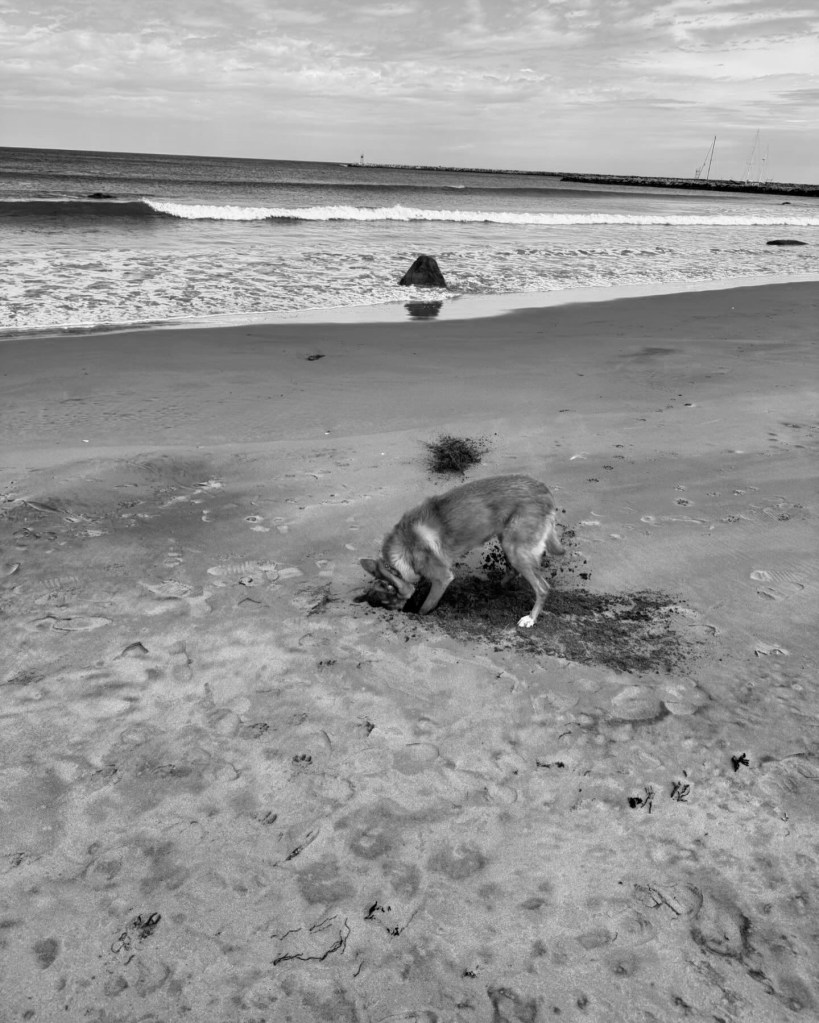
Photo Credit: Jessica Denzer, private collection.
 L'Esprit Literary Review

One response to “In the Garden Where the Bones are Buried”
Ich und Du.
LikeLike