Miah Jeffra
Fiction
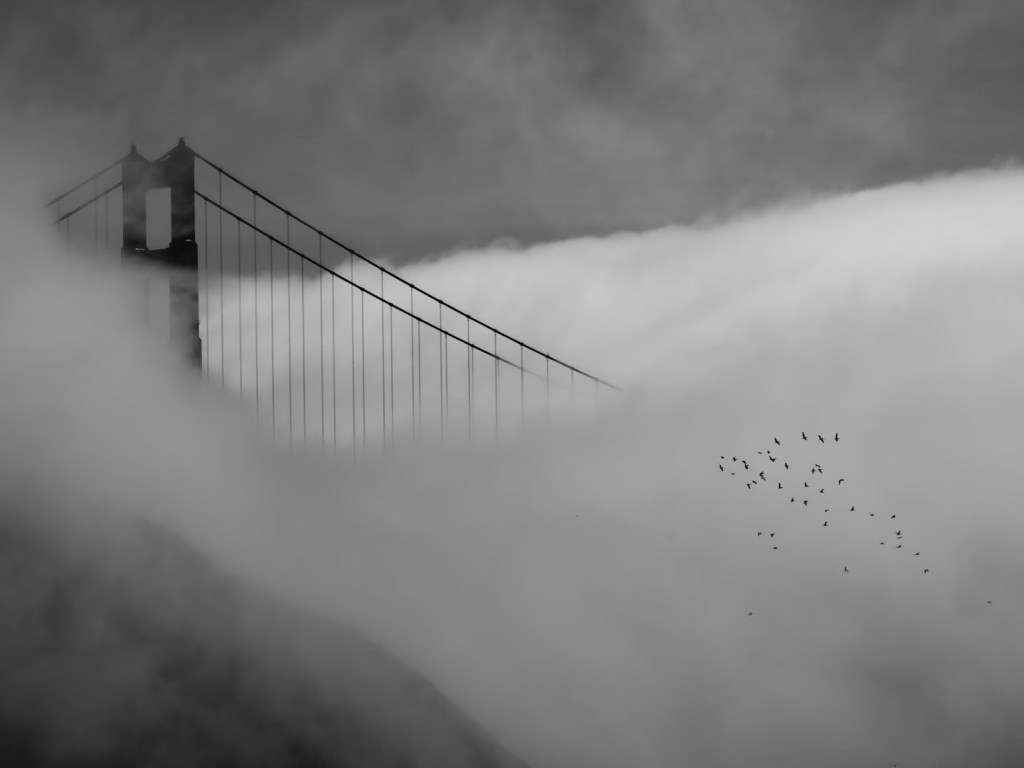
Structures—big things—are making me panic lately. Large, beyond-the-size-of-human things that we dwell in, that we swarm inside, that we rely on to stay intact. Made by us. Every time I bike or drive or walk over the Golden Gate Bridge, I can’t help but marvel how this 85-year-old thing stands in the water so confidently. Why doesn’t this crashing wild water erode the foundation to the point of collapse? I ask this to my roommate, Sean, who prides himself on his physics knowledge, even though he is a photographer for hipster hoodrats in the Lower Haight. We are driving over the Golden Gate with our friend Marie to get Dippin’ Dots in Sausalito.
Well, eventually it will fall. I mean, it is water, he says.
Exactly, I say. Look at what it does to earth, to metal, to skin.
Nothing is indestructible, he says.
Then, why do we drive on this thing?
Why are you asking this while we are on the bridge, Marie asks.
The bartender at The Page and a tremor (un)plant the idea. I am sipping my pilsner, the hiccup of earth occurs, and debris from the ceiling dusts the floor. I look up. Everything looks the same. Large brick slabs nestle between lines of concrete mortar. I look at her, and she’s shaking her head. I share the empirical probability that if shakes like this happen enough, the ceiling could fall—the sky is falling, the sky is falling. She laughs, and then stops laughing. Wow, that’s deep, she says.
Why? I ask. Her eyes stay fixed on the ceiling.
It ends, man. You know? It ends with the nothingness that, like, when the whatever that was whatever has finally ceased, you know, being what it was, and becomes many things, or many parts of things. Or maybe it’s nothing at all. You want another beer?
I stare at the ceiling with her.
It begins with the observations, quick glimpses, interstitial musings that bob now and then, when the air isn’t too hot or cold, when the spaces between our doings aren’t busy swatting away bugs from our face, yelling at drivers who cut us off, pushing ourselves into the world with a force that could never be mistaken as listening. A woman is talking on her cell phone during her lunch break. Her panini sits patiently as she pulls a strand of loose hair, fiddles and releases it into the wind. The hair dances nervously, snakes in its weightlessness, then settles on the back of a chair filled with a man who is talking on his cell phone during his lunch break. He doesn’t have much hair left. But he does pull on his nose. He smears the crusty mucous, some on his creased slacks, some on the edge of the table. He misses his mother, who passed away the previous September. He is considered attractive by several people. So is the woman. She has already forgotten about her strand of hair, but it has only begun.
In the bathroom after school. I am burning paper because it is punk rock. Trying to convince Chris Curtis that we were supposed to join our bodies in splendid oneness, I watched the fire pare the white paper into gray ash, then fall, disappear out of sight, wondering where it went. Where was this nothingness and suchness?
I was watching the mini-series adaptation of Angels in America (I had read the play, and loved it immensely, more than the mini-series, but then is not when I got a boner, and that is what this is about.) The actor playing Louis says to the actor playing Mormon Joe that smelling something is the particles of the object coming into you. The object—that very real thing—sloughs off bits of itself at all moments, every moment, a little bit and a little bit. Upon hearing this I get an astonishing boner.
Making out with Karen Fiorito in the tenth grade, I unexpectedly got a nose bleed. She didn’t care, even laughed, while my tongue was licking the back of her teeth. Afterwards, after the wetness had dried on her skin and panties, she recoiled only at the thin brown line down her neck. I touched it. Where it was dry, it rubbed off and disappeared.
My father opens his hands and says nothing when I ask him why he is my father, why I am his son, the vastness of the question in my small five-year-old mouth. He sits on the porch, the wicker chair, facing the stretch of Blue Ridge woods that was infinite to me then, even though the road ran 100 meters beyond. The question feels authentic, but I can feel its danger. I stare at his hands, my chest barely higher than his lap. Even then, I know something abides in the open hands—a fullness, a thing, the answer I seek? We open our hands, something goes. What?
Sausalito eases itself within the final breath before the Headlands exhale into the Bay. We pass the storefronts designed for white people who vacation by eating. The Dippin’ Dots cart is next to a restaurant that rests itself over the water, perched on a pier, a series of exposed wood beams disappearing into the murky water. Barnacles grow all over the wood.
See, look at that, I say. Isn’t everyone freaking out about that building relying on wood in water? I mean, isn’t it soaking, softening, rotting?
Well, yeah, I guess, says Marie.
Then, I say.
Eventually, my roommate says.
Then what? I say.
Then, they build another one that won’t rot for a while, he says.
I ball my fists and shake, and let out a contained growl, only for them.
Dippin’ Dots! Marie says, and runs along the pier towards the cart.
One week after we shared a bed, you looked at me from across the car that shielded you from my barbed questions. Your eyes showed that you had rubbed me off, and I disappeared from you: the mucous, the semen, the spit, the hair, the particles of me, all gone. Where did it go? If it is a gift, who have I given it to, now? Do I have any say in this?
I stare at my brick ceiling—when will it corrupt enough to give up and fall on my face while I sleep? How many shakes will it take?
We made the Titanic, we made the Hindenburg, we made the Challenger Shuttle. We made Fukushima. We make love.
I am a structure. Dust is skin, floating in the light. When we sleep, we not only shut off the waking world, we dissipate, pieces of us leaving, rolling in the soft motion, in stillness. Air and water move around us, taking bit by bit. We stand, and we can hold up many things, and we are certain, even as the little bit and the little bit leave. How many shakes will I take? And what of the violence?
When I was small, a fierce and tight little bud of my eventual self, my grandmother swayed with the stories of every living thing. The late summer would swarm with dandelions, and when they were ready, the white fluffy seeds would take flight. The flower knew of its end, and would let go in one last grateful gesture of life, a soft woolen sigh into the air. And off the seeds would go, twilling with the air and light. I chased them, delighted when they grazed my outstretched palm, but I had no desire to fold my fist around them, and they’d take flight again. My grandmother looked off, beyond me and the seeds, over the horizon and somewhere beyond. It was a face I couldn’t have understood. My father opens his hands and says nothing when I ask him why he is my father.
One last grateful gesture of the mystery, and why it should remain. The world breathes, in its own woven way.
We are sitting on the dock, Marie, my roommate, and I, facing the Bay on a sunny day. Below us, the water. We are supported by rotting beams of wood. We are nibbling our Dippin’ Dots—nibbling renegade flakes of skin, sea water, salt, early morning sneezes, fingernail crud, snot, rust, cat hair, dog dander, fly eggs, cum, sweat, pus, shit, fish ick, toe jam, rotten meat, fungus.
This is fucking good, my roommate says, little bits of Dots sticking to his hipster whiskers. Marie is too busy tonguing the dots to say anything at all.
Yeah, it is, I say.
Miah Jeffra is author of four books and co-editor of the anthology Home is Where You Queer Your Heart. Work can be seen in StoryQuarterly, Prairie Schooner, The North American Review, ANMLY, Epiphany, DIAGRAM, and many others. Miah is co-founder of Whiting Award-winning queer and trans literary collaborative, Foglifter Press, and teaches writing, decolonial studies and cultural theory at Santa Clara University.
Photo Credit: Aaron Howland

