Linn Hansen
Short Fiction
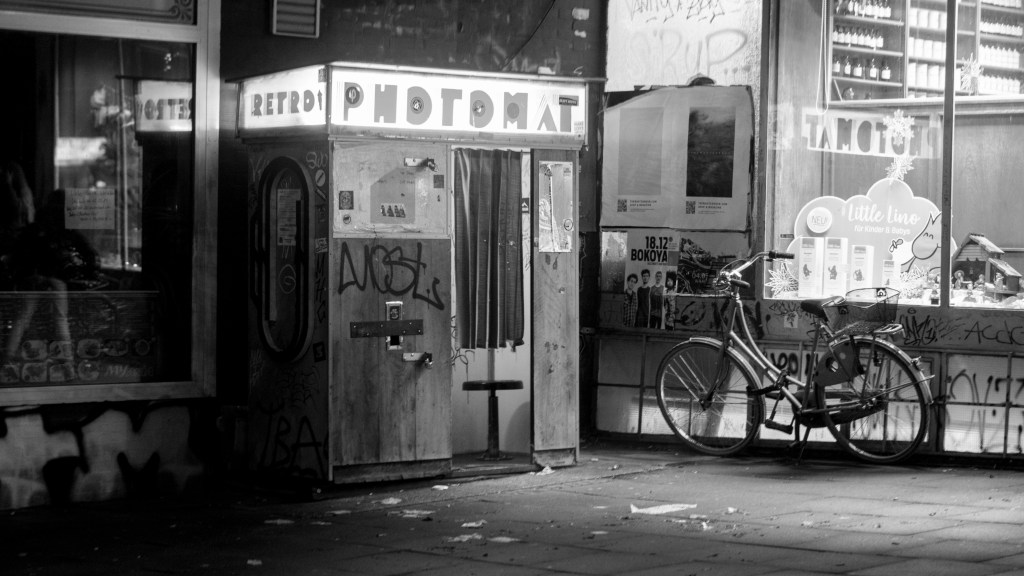
Stummfilm won second place in the 2025 Clarissa Dalloway Prize Prize for Short Prose, judged by Diane Josefowicz.
Diane’s Citation:
I loved “Stummfilm” for its deadpan humor and fierce dedication to the point of view of its quirky narrator. While quietness and even silence (the “stumm” of the “Stummmfilm”) are thematically important, the story is not what I’d called “quiet.” The emotional riptide here is strong, and I found myself repeatedly swept away.
That summer I had a job documenting the damages of various construction sites around the city. Actually, I wasn’t the one documenting them. Someone, or several someones, whose faces I never got to see, moved around town to do their inspections on a certain type of construction overseen by this specific company. I imagined them cartoon-like, all dressed in bright yellow vests, multiplying along the way until a whole horde of them would infuse the city. I saw them slip through cracks in the granite, scrambling up and down metal structures like ants, clipboards in hand, pens behind their ears. Although they probably wouldn’t be using pen and paper to write. Presumably they had something more high-tech at their disposal.
Whatever it was they recorded their findings on, the result of it was presented to me in documents sometimes spanning a hundred pages, the damages noted as key words next to photographs of whatever held the damage. Bland, unemotional images, cropped to neat squares, everything evenly in focus, centred on the rust eating into some type of steel, invisible scratch marks along metal, or the microscopically chipped edge of something. Certainly no aspiring photographers in the pool of those inspectors.
My job was to look for the given key words in another long document, then copy and paste the corresponding, fully written-out paragraph back into the first document. The same procedure applied to the other field in these reports, which was a proposal on how to fix the damage.
I thought that was nice. Not just pointing a finger at what was wrong, but also making a suggestion on turning that wrong into a right. Constructive criticism.
This was something I would have liked to show the woman who ran the writers’ workshop I had attended earlier that year. My idea had been that this would jump-start the third rewriting of a novel I had thought up a few years ago. Five, to be precise. I did an extensive calculation that proved that those five years made up half a decade. I had been working on my novel for half a decade.
The workshop conductor was an elderly writer, who had a notable amount of book publications in her wake, and who disregarded her chair and instead crouched along the edge of her desk. I spent the introductory half hour eyeing the loose-fitting sandal on her left foot that was constantly on the verge of falling off. It never did, and when she finally gained safe ground again, she had moved on to explain why there were no well-written first-person narratives around anymore.
My novel was written in first person, of course. Our debate ended when she took an excerpt of my writing and pointed out that, while I alluded to a traumatic event in the narrator’s past, I never went on to define what said trauma was.
I said, the narrator already knows, so they wouldn’t be spelling it out.
She said, if they’re not spelling it out, they would still have it on their mind.
I said, it’s something impossible to describe.
She said, then you have failed as a writer.
I said, okay.
I had gotten the damage job by responding to an ad online that said a typist was needed. I found this to be a somewhat inaccurate description, when really a copier and paster was needed, but I didn’t bring this up in the ensuing interview. No experience in the construction industry was needed, not even a basic understanding of it.
“You don’t need to know what the cow is thinking in order to beat the butter, do you,” the lady conducting the interview said.
I liked this explanation not just because it compared the copying and pasting to the act of beating butter, but because it put the cow at the top of the power game.
The only requirement for the job was that you had a working knowledge of Word (the first document) and Excel (the second document). Working knowledge, it turned out, meant knowing how to open and occasionally save these documents. Apparently that put me before the other applicants, because I got the job. I was happy about it until I realised what I was happy about, and then it became just another piece in my growing collection of random things that constituted my life at that point.
So I spent the summer looking at damage, the whole damage of the city documented in plain, purposeful photographs and factual, pre-packaged writing. Damage noted in endless, sprawling pages that didn’t need clipboards because they weren’t actually real, tangible. The damage itself, to me, immense and never-ending as it was, seemed unreal. Clearly there but barely out of reach.
The job was a fully remote one and had no fixed working hours, as long as I got a certain amount of hours done every week. My hours were logged on a website created specifically for that purpose. It recorded the exact time, down to the second, at which I clicked a button for ‘Start’ and another one for ‘Stop’. I wondered if anyone from the company paid me enough mind to form some kind of opinion about my nocturnal working rhythm.
When I had started the job initially, I was still seeing him. His own job, which he hated, required him to work from evening until late into the night, and so it suited me to be able to do the same.
Then, a couple months later, when he all but disappeared, I still had the job, but the hours of it dissolved into floating blocks of time across my days and nights. It was somewhere between part-time and full-time, just enough for me to get by on, and it left me with plenty of time around it to fall into a deepening hole of my own choosing.
Still, even inside a hole you need to busy yourself somehow. I couldn’t cry, but I had various activities to pass the time until I would look at the city’s damage again.
I had found a little lump at the back of my head that I felt around quite a bit. Actually I had re-discovered it, it had been there all my life and, as someone who should know had assured my parents, was nothing to worry about. A little hiccup of my scull. Everything around your head and face feels disproportionally larger than it is, and so that lump provided a good field for my fingers to probe around during long, not altogether unhappy, stretches of time.
I also created a lot of playlists. My neighbour to the left had discovered guitar as a thing, and at least once a day I could feel my body contract as soon as the first wobbly note would sound through the thin wall while the instrument was being tuned. They weren’t bad at playing, but they always played the same, and they didn’t do it according to my own time schedule, like during those twenty minutes I would be out getting groceries.
That neighbour was clever. They wanted my attention, and by setting up this habit, they were certain to get it. After a week or so they didn’t need to play a single note for my mind to be constantly half-focused on the space behind the wall, anticipating, almost-hearing that first string being tuned.
I bought the kind of earplugs that cost about fifteen quid a piece and that expand in your ear to fulfilling numbness. Or so the packaging said. They didn’t block out the lower bass notes from next door. Clearly my neighbour had seen me buying those earplugs through the glass door of the pharmacy and had hence decided to only pluck the lower E string. Again and again, in a rhythm that was just random enough to not turn into background noise.
So I created a bunch of playlists that I could blast at full volume through the headphones placed atop my plugged ears. Every time a song ended there was that brief tension, while I listened through the foam and hard plastic, the wallpaper and bricks for those strings being plucked. And being plucked they were. I changed the settings of the streaming platform so the songs would cross-fade into each other, never allowing for a second of silence.
I must have listened to hundreds of songs that summer I never knew the end of. A last surprise note, a moment of silence, a slow fade – I would never know.
My friend would tell me how nice it was to live in a building block with other artists, while I had elaborate fantasies of wrapping the lower E string around someone’s neck. I couldn’t imagine the neck too well because I had never seen that neighbour face to face, but I imagined it to be either exceptionally long or exceptionally short.
My friend found this offensive. Apparently there had been a hamster in her childhood this had happened to. I tried to figure out what a hamster had been doing with a lower E-string. Do hamsters even have necks?
To look at the damage, I went to a corner café. I don’t know why it never occurred to me to do this in my free time. During working hours, I suppose, I felt more mobile. Like a wind-up toy whose string has just been pulled, letting it skitter just far enough down the street to assume position in one of the window seats. There was music there too, but the guitar riffs in those songs had not been designed specifically to penetrate my body and soul, and so it was a pleasant background noise. The only problem with the café was, I got distracted a lot by what went on beyond the window.
It was looking out across a main road that was busy at all times of the day and evening, and my head turned from left to right following the motions. Cyclists often made eye contact with me while passing by, even with that layer of glass between us. Something about my face, my expression, or the look in my eyes made them look back, cling to whatever they saw for a moment.
Maybe it was because of how I looked at them. Maybe it was out of curiosity about who it was who was looking at them. Maybe because people didn’t make eye contact nearly as often as you’d assume. I kept thinking, one of these days one of these cyclists will drive right into a lamp post and it will be my fault.
I wondered if the company I worked for had a hand in the material the posts were made of, and if that damage would show up in one of my reports.
I liked the image of myself sitting in a café working. I liked looking at the edge of the screen against the flower vase behind it, the coffee cup beside it. This was a recurring theme I discovered: looking at the world in excerpts like magazine cut-outs. I liked the square-shaped view of things, but not the actual big picture.
Was this what the inspectors felt, the reason they cropped their damage photos into squares? What would the full picture around the damage amount to? Would it be just more damage? Or would it make the damage itself seem suddenly insignificant? How could anyone care so much about a tiny scratch along a huge piece of equipment?
Those inspectors were idealists, I decided. They tried to heal the world with all its rusty bumps and scratches. And they had got stuck with someone like me, who pretended to be on their side, when secretly I relished feeling the bump on my own head.
His head was free of bumps. I should know, I had spent hours combing through his hair, making sure I’d remember every single curve and line, everything that made up his particular shape. Only when I held his head like that were we eye to eye. He’s a little taller than me, but in my mind he’s towering several feet above me.
His hair was unexpectedly soft, and so were his hands, especially his palms.
His hands summed up a lot about him. They were much larger than mine with long, slender fingers, marked in various way. Skilled hands, whose skill he scoffed at. Strong hands, whose strength he didn’t always know.
Once on our way home, when he was drunk, he tried to affectionately rub the back of my neck. He miscalculated the power of his own fingers and squeezed until a white hot glow shot through my muscles and I had to pry his hand loose.
By the height of summer the damage had spread. I received reports not only documenting the city, but its outer suburbs as well. The damage was getting ahead of us. By that point I was emotionally invested. We can fix this, I promised the faceless inspectors I pictured clutching thermos cups of coffee and soggy white sandwiches while commuting in and out of town.
I had spread too. I was no longer glued to the wall of my studio apartment listening for strings being plucked. My neighbour had stopped playing, or maybe they had moved. I felt a sudden penetrating loneliness at the thought. I started to go on elaborate, rambling walks through the neighbourhood. I wandered dodgy side alleys after dark in hopes of getting mugged. Nothing too bad, just a nice pickpocket to get a little human contact.
I still couldn’t cry. I was worried that I might lose my mind, until nothing but that bump, that hiccup of my head would be left.
Inside my head there was a hiccup as well. Like the skipping of a broken record, it would play back a mental inventory of all the things I had left in his apartment. Books, cards. A set of tea lights. Socks. A notebook. I hadn’t forgotten those things, they had all been gifts to him once. Now those things couldn’t possibly have forgotten me, could they?
Traces of myself in the geometry of someone’s unravelling life. He would stumble upon those traces, and he would remember: this was me.
I wouldn’t allow him to simply erase me from his mind, not even in my imagination.
Imagination was all that was left. The inspectors wandered unknown territory at the edge of the county, while my imagination wandered the edge between past, present and future. I presented great speeches for previous conversations, arguments with him that had barely been such. It takes two people on equal footing to have a real argument. And if it’s only their anger that lets them, kicking and screaming, rise to that same level for the moment.
But kicking and screaming was never in my repertoire. I have the required limbs for those moves, the right-sized tongue and mouth for those sounds. It’s something deeper I’m missing. Something that would let me describe the indescribable, turning the heads of writers who have had too much success to be talking in anything but passionate absolutes.
He described the indescribable. It’s hard to disregard someone snapping at you, yelling at you in public, then dropping out of sound and sight, out of sound mind, after you’ve combed their hair, felt the weight of their head, while listening to the indescribable. It’s harder than you could possibly imagine, no matter how long your damage report has become.
And then he was gone. I was finally cheated out of making that decision myself. My reports became more forceful in their proposal on how to fix the damage. You can’t go through life doing everything half-arsed or you’ll end up with nothing but a bump to feel around, and nothing will ever be fixed, I would remind the inspectors.
I imagined running into him, usually during my grocery excursions. I wouldn’t cut him. That was for people living in movies. I wouldn’t deliver the all-annihilating speech I frequently practised either. I wouldn’t be telling him anything new in it. The best approach would be friendly distance. Like there was no point in attempting to have any conversation beyond the unavoidable, because that’s exactly how it was. I knew how it would go. It would end up with me reading his damage report, while my own rusty scratches would be left unmentioned.
By the end of the summer I was let go. Someone had looked at my damage reports and discovered my own additions:
“Corrosion protection damage” but it’s going to be ok, I promise
“Rust leaking at lower bolt” but whose rusty heart doesn’t leak from time to time
“Replace spackling compound in hole” filling an emptiness will only leave you with an emptiness full of something
They suggested I look for a job in creative writing.
I went to the cinema. I didn’t care what they were showing, as long as it was something old. I needed to look at square-shaped images.
It was a Monday in late summer, a film shown during that indecisive time between morning and noon. There was only one other person there. Trailers had already started, and I could only see their silhouette. Nothing to define who or what kind of a person this was, except the outline of dark hair against the huge, bright screen.
I sat down beside them, careful not to look at them. Like that would preserve the illusion that I had picked that particular seat at random. They showed no sign of having noticed me.
The film finally started, and that’s about all I can say to it. When the opening logo of some production company appeared, the person beside me took my hand. I had laid it across the armrest, tentatively only taking up exactly half of it. The other hand was faintly warm. Neither smooth nor rough. They had placed their fingers loosely around mine. I didn’t turn around.
The film might have been black and white, without sound. Or it might have been in full technicolour with the score of a twenty piece orchestra. I didn’t see colours, I didn’t register noise.
For the next hour and a half, that screen was reduced to a flickering line of light along the periphery of my vision. I didn’t look at the hand I was fully clinging to now. I was starring into the undefined, which was located by the row of seats in front of us.
A silent film of my own was reeling off. In the language that now feels less like my own, the word for it is ‘Stummfilm’, ‘stumm’ meaning not just ‘silent’ but ‘mute’. A muted story with its muted character. Recording the damage of the city. Recording damage, but proposing – tentatively, anxiously, empathetically – ways of fixing it too.
Tears were streaming down my face, readily and openly.
Linn Hansen is a German visual artist and writer based in Dublin. Her work incorporates a variety of media, including photography, filmmaking, illustration and creative writing. She is currently working on her first novel, as well as a short story collection.
Photo Credit:Linn Hansen is a German visual artist and writer based in Dublin. Her work incorporates a variety of media, including photography, filmmaking, illustration and creative writing. She is currently working on her first novel, as well as a short story collection.
 L'Esprit Literary Review