Ea Anderson
Short Fiction
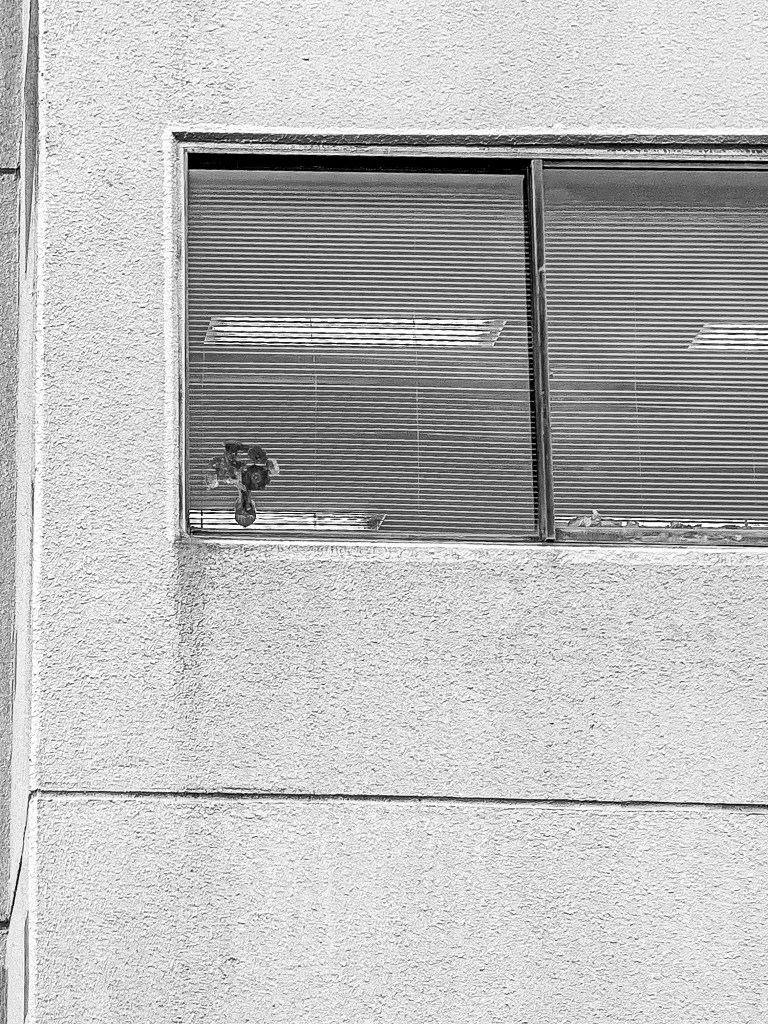
Lindsay’s office lies on the 7th floor of a tall building. The large windows face a side street with low, newly planted trees and small bins next to a few benches. Across the street are other tall office buildings with large windows. Lindsay likes this area in the middle of the city where nobody lives, where people only go to work and out for lunch, or pass through at night on their way to the theatres and cinemas.
Lindsay’s office is really just a cubicle in an open office with at least seventy other people, all sitting in their own little cubicle made up of white plastic walls. There’s a constant sound of mumbling voices. They sell books over the phone, books like Mistral’s Daughter and I’ll take Manhattan. On the front covers of the books are drawings; a pretty woman’s face, a red rose, or a silver outline of a big city skyline on a black background. The titles on the covers are written in large, intricate, shiny and glimmering letters. Inside the books, some of the letters are blurred as if they have been sucked into the slightly rough paper. Lindsay has never read any of the books but she has them all at home in her flat. The office manager urges them all to read the books and when a new one is added to their list, they can pick up a copy when they leave at night. The books are neatly arranged in a pile against the wall by the lift. The spines face outward, they are colourful and call out to Lindsay. Lindsay always takes one, she keeps them in a bookcase next to the toilet in her bathroom; for guests, should she have guests, to read if they feel like it, or for them to steal, if should they get the urge to slip one into their bag.
If you show up at the office early enough, you get to choose which area to call; there’s lists of names divided by areas; north, south, east and west. Most people like to call the west. In the west are rich housewives who don’t know what to do with their time and money. They are easy to sell books to. The worst area, Lindsay thinks, is south. The south is full of lonely old women who won’t stop talking and since you get paid according to the number of books you sell, you don’t have time to talk for hours. But Lindsay feels sorry for these lonely old ladies and listens to their stories about grandchildren and holidays to Mallorca for hours. Normally though, Lindsay gets to choose which area to call; she arrives at the office early and leaves late.
In her lunch break Lindsay goes to a deli called Hullabaloo with one of her colleagues called Bethany. Lindsay goes to Bethany’s cubicle. She puts her hands on the edge of Bethany’s cubicle and leans her chest against it. ‘Lunch, Beth?’ she asks. Then Bethany has to go to the toilet first to put on lipstick. She says a woman should always wear lipstick since you never know when you will meet your next husband, it could be on a night out, it could be in the supermarket on a dull Sunday morning or in your lunch break at Hullabaloo. Sometimes Bethany lends Lindsay some lipstick, but even Bethany thinks it looks slightly strange on Lindsay, with her rather full lips and otherwise delicate features.
At night after work, Lindsay goes home. She normally walks a bit of the way and then takes the metro. In her own neighbourhood she stops for groceries at the shop owned by an old couple. The woman always gives Lindsay sweets, as if she was a child. Lindsay doesn’t mind, she likes the old woman who keeps smiling and nodding. ‘Thank you,’ Lindsay says, ‘thank you,’ and keeps nodding herself. The sweeties are wrapped in white paper with faces on that look like something from a cartoon. The sweets are sticky and come in bright colours. She keeps them in a round fish bowl bought for the purpose. Lindsay likes this bowl of sticky sweeties. It sits on a shelf which Lindsay calls her treasure-shelf. On it are conches found on travels, a music box playing We’ll meet again and a photo of her parents on their wedding day.
Every Wednesday Lindsay’s local cinema shows old movies from the thirties, forties or fifties. Lindsay likes these movies, she likes the way they speak and dress in the movies, the love stories, the detectives, the way the camera stays in close-ups for a long time, these actors’ and actresses’ faces showing despair, love or sadness, a diamante tear in the corner of an eye.
About once a month, Lindsay stays in town after work. Sometimes she just goes out to look at shops, to a museum or to have a nice meal on her own. Other times she goes out with Bethany. But most nights she stays at home. She leaves the radio on while she walks around her flat tidying. She likes listening to the radio. Lindsay has been alone for a long time and often catches herself talking aloud to the radio, and then Lindsay laughs.
This Wednesday morning Lindsay is the first to show up at the office as usual. By noon, she has already sold ten books. She decides to make one last call before lunch. The phone rings for a long time, then a man picks up. ‘Yes?’ Lindsay gives her sales speech, she does it fast, she’s hungry and just wants this call over and done with, but when she’s finished nobody says anything at the other end.
‘Maybe as a present for your wife,’ Lindsay says, still nobody answers. ‘Well, have a nice day.’ Lindsay is just about to hang up when a man at the other end says her name.
‘Lindsay?’ he says.
But Lindsay hasn’t told the man her name, they are not supposed to. Lindsay doesn’t answer, could it be a coincidence, or some of her colleges playing a trick on her? Lindsay gets up from her chair and looks around the office still holding the phone to her ear, but everybody is working in their cubicles, nobody is looking at her.
‘Is that you Lindsay? Lindsay Jones?’
Lindsay sits down on her chair again, ‘Yes, my name is Lindsay.’
‘It’s Robert. Robert McCullum.’
‘Robert,’ Lindsay says because she doesn’t know what else to say.
It’s eleven years ago since Lindsay saw Robert. It was at a train station and it was October. Lindsay and Robert had been together for five years, since their teens. They lived in a flat together and that last summer they had travelled together. They had been to the Greek Isles and walked naked on secluded beaches, they had visited Rome and Venice, driven down along the French Riviera all the way to Barcelona and walked in the bare, stony mountains of northern Spain. When they came home, they had two weeks left of their holiday before they had to start university again, Lindsay to continue her studies of Art History, Robert, Politics. But less than a month before that day at the station, both Lindsay’s parents died suddenly the same day.
Lindsay and Robert were supposed to have visited her parents that day, but her father called sometime before lunch to cancel. Her mother had fallen off a ladder while tying up the wisteria and hurt her leg. They didn’t think it was anything serious but they thought they’d better get it checked out at the A and E. No one ever found out what caused the accident but for some reason the car swerved off the road and hit a tree in a field. Lindsay knew that tree, she had passed it most days on her way to school as a child, and often she would go up to the tree and stand below it, it had such a pretty pattern on its trunk and lichen grew on its branches. Now the front of her parent’s car almost folded around that same trunk. They both died instantly on impact.
At first Lindsay seemed to be in a shock-like state, she cried hysterically in the hospital, then she laughed in disbelief. At home in their flat, she was quiet, staring into the empty air. Robert ordered pizza, he told her to drink water, hugged her every time she got up to go to the bathroom because of all the water she had been drinking. He stroked her hair and held her hand while they watched When Harry met Sally. When the movie was over Lindsay wanted to watch it again and so they did.
But over the next few days, Lindsay started feeling something like relief, as if she had been set free. It started as little flickers of excitement while she was showering or chopping vegetables for dinner while Robert was checking on the roast in the oven. Little sparkles shooting up from somewhere inside her and bursting on the surface with a feeling of all-powerful freedom and opportunity. Lindsay would stop whatever she was doing and astonished note this brilliant feeling of having been cut loose. She would look at Robert, thinking that he must be able to feel it too or maybe even see it radiate from her, but he didn’t seem to notice.
Over the next few weeks this feeling settled in her as something strong and solid, not as flickers of excitement anymore, but as a lasting base of open opportunity in her, an overpowering feeling of freed soul. Lindsay systematically took care of everything, she arranged the funeral, bought caskets and flowers, she called her parent’s lawyer and got him to put their house on the market right away. Around everything she did, was this gleam of luminous vitality. She sold her parents valuable antiques and paintings, and got a company to pack the rest of their belongings and put them in storage. She only kept their wedding photo, the one that now sits on her treasure-shelf.
Robert worried about her, he wanted her to grieve in what he called a natural way and saw her behaviour as a sick coping mechanism. He had moments where he even felt afraid of her. He asked his parents and brother to come over to observe her. ‘Give her time,’ they said.
Late in September when Lindsay was supposed to start university again, she didn’t. She said she was tired of being inside all the time, she wanted out, air and trees and the sea, mornings and nights in the city and country, she longed for everything and she wanted to go get it. She said something like that to Robert while she was packing.
‘This is crazy, Lindsay, you are not yourself right now.’
‘Yes, I am,’ Lindsay said.
Then Robert drove her to the train station, and that was the last time they saw each other. He waved from the platform, and she waved from an open window in her coach while the train started driving east.
She called Robert from Portugal after a week and said she wasn’t coming home just yet. A week later, she called again from North Africa, then slowly her calls got fewer and fewer until they stopped altogether.
Lindsay travelled for three years. She travelled Europe, she travelled Asia, she talked to monks in temples, danced on the beaches of Goa at full moon parties. For a while, she lived with a man in Naples with mafia connections. When she got tired of moving around all the time, she got a job at a deli in Toulouse, then a job as a custodian at a museum in Paris. Finally, she decided to go back to her home country. She felt full and empty at the same time. A fear of using up all her freedom was sneaking up on her. ‘I shouldn’t use up all my freedom on being completely free,’ she said. So she went to this city, got this flat and this job as a salesperson of books like Mistral’s Daughter and I’ll take Manhattan. She disconnected herself from her traveling self to border up the feeling of freedom and keep it. She gave her freedom walls and she became this Lindsay, content with a simple life, a slightly closed, naïve Lindsay. And she possibly became even happier.
‘Robert,’ Lindsay says again into the phone.
‘Yes,’ Robert says. He suggests they meet, just for a quick bite or a drink. ‘I would like to see what you look like now,’ he says.
Robert doesn’t know the city that well, he’s just staying at his parents’ flat for a few days while they are away, so Lindsay arranges the restaurant. She books them a table at a Spanish place she has seen an advert for on the metro.
Lindsay is deliberately late. She stands on the street in front of the restaurant for a while and watches Robert through the windows. He is sitting at a table in the middle of the room, he looks wider, his back and shoulders, his hand around a glass. He keeps lifting the glass to his mouth and drinking. Then Lindsay goes inside. A waiter takes her coat and leads her to the table.
‘Oh my God, Lindsay,’ Robert stands up, ‘let me see you.’ He takes Lindsay’s arms, holds them out to the sides and looks at her.
Lindsay smiles, she feels uncomfortable in her red dress with polka dots and a full skirt. Lindsay wishes she had worn something darker and more mature. Her fine, light brown hair frames her delicate face. They lean over the table and kiss each other on the cheeks, then they sit.
‘Where do you live now, Lindsay, far away from here?’
‘No, not too bad.’ Lindsay pulls her chair closer to the table, she takes a book from her handbag and hands it to Robert.
‘For your mother,’ she says.
Robert flicks fast through the book, the air from the pages lifts a lock of hair from his forehead. His hair is still blond and his eyes dark blue, but there is something slightly puffy about his face now, the way a face can look if you haven’t slept enough or if you have slept too much.
‘Well, thank you,’ he says, ‘I’m sure she will like that.’ He puts the book down on the table next to his cutlery. ‘Now, what will we have?’ He opens his menu.
Robert lives in a town up north. ‘It’s just so fucking freezing up there,’ he says. Robert is flimsy and heavy, he eats fast and takes large sips of his beer with his mouth full of paella. He put his glass down hard on the table. He’s been married for ten years. He looks up at Lindsay as if he wants her to say something.
‘What’s her name?’ Lindsay asks and her name is Samantha.
The fat from the Spanish food sits as a layer inside Lindsay’s mouth. They talk about everyday things, why people in warm countries eat spicy food and people in cold countries don’t, Lindsay’s job, Robert’s garden and garage. Lindsay nods and chews even though she doesn’t have anything in her mouth. Robert looks like a car salesman. Lindsay doesn’t mind car salesmen. He works for a union. Lindsay sells books. Lindsay feels nauseous, it’s not Robert’s fault. It’s not directly uncomfortable.
Robert lets Lindsay pay, two gazpacho, one paella, one Ropa Vieja, three coronas. There’s a drawing of a skeleton with a red scarf, smoking a cigar on the bill. Robert leaves the book from Lindsay on the table.
They walk down the street, past shop-windows and billboards, cinemas and theatres.
‘It’s fucking freezing here too.’
Lindsay is not cold and there are little pearls of sweat on Roberts’s upper lip.
Robert walks Lindsay down the stairs to her metro. They walk through the passageway. Suddenly Robert grabs Lindsay and presses her against the tiled wall at the station. Lindsay lets him do it. He puts his hands up under her coat, through the opening down the front of her dress, touches her skin, squeezes her left breast. Lindsay feels the hard, cold tiles against her back, it seems to her, the pressure of her body could easily soften up the tiles, let her sink slightly into them and leave an imprint of her body. As if her body was harder than it is and the tiles softer, as if her body and the wall were made of a similar substance, familiar and maybe a little like love. It’s a strange feeling of coherence, Lindsay is absorbed, her eyes are closed, there’s a peaceful expression on her face, a small enigmatic smile.
They stand like that for a while, Lindsay against the wall with closed eyes, breathing calmly, Robert grunting, fumbling around on her skin under her dress. Then he suddenly stops, Lindsay opens her eyes, they look at each other.
‘Damn this,’ Robert says, he pulls out his hands, turns and runs down the passageway and up the stairs. Lindsay looks after him, then she adjusts her clothes and walks to her platform, she feels strangely at ease.
But when Lindsay is back home at her flat, and she has put her pyjamas on and is lying in bed, she can’t stop thinking about Robert. For a while after Lindsay came back from her travels, she kept having these daydreams about meeting Robert. The kind of daydreams you can have about school reunions and old boyfriends. Where you look better, handsome, sturdy with stronger features. Where your life has turned out perfect, as a dream. A life other people envy. In none of the daydreams, Lindsay was as she is now, slightly awkward, naive, working as a book salesman.
Remembering these daydreams now disturbs Lindsay lying in her bed. She looks at the clock at her bedside table, it’s only ten fifteen. Lindsay gets out of bed, she walks through her flat barefoot. In the bathroom she goes through the bookcase and finds a copy of the book she brought earlier that night for Robert’s mother. She puts it in her bag, she puts on her red dress again and leaves the flat.
She has only been to Robert’s parents’ flat once, they moved there just before her parents died, but she remembers where it is. When she rings the doorbell, it’s five past eleven.
A very beautiful woman opens the door, tall, with reddish hair and extremely green eyes, her movements languid. Her fingers are abnormally long, Lindsay notices them on the doorframe. The woman wears something long, loose and white. She leans against the door and tilts her head.
‘Is Robert here? He left this,’ Lindsay holds up the book.
The woman looks at Lindsay. ‘You are Lindsay,’ she says. She puts out her hand with the long fingers. ‘I’m Sam.’
Robert’s wife shows Lindsay through to the living room. They are house sitting for Robert’s parents and Robert isn’t home yet. ‘So, it’s just us,’ Sam says. Robert stays out sometimes when they are in the city.
‘Where does he go?’ Lindsay asks.
Sam shrugs, ‘Around.’ She opens a cupboard under a bookcase, takes out two glasses and a bottle of sherry. People drink these kinds of drinks late at night, in pockets of life, after receiving bad news or waiting for bad news. When nothing else seems quite right. It’s given to grievers. Lindsay vaguely remembers drinking sherry around the time of her parents’ death.
The furniture in the room is dark, big chesterfield couches in brown leather, enormous bookcases. There’s only one light on, a brass standing-lamp in a corner by a window. It has a smoke-coloured glass shade and hardly gives off any light. It’s so rare Lindsay is up at this hour. They sit down on one of the couches. Sam puts her legs up on the coffee table.
‘Where did you go, back then?’ Sam asks and maybe it’s because of Sam’s languidness, the fact that she’s Robert’s wife or simply because it’s late at night, Lindsay tells her about Portugal, how there seemed to be music everywhere, her first small, empty hotel room and this tight string of happiness. She tells her about the man in Naples who looked a little like an Italian Robert when Robert was younger. Sam laughs, ‘There’s absolutely nothing Italian about Robert.’ Sam herself is a ceramicist, she tells Lindsay, though Lindsay hasn’t asked. ‘I’m a ceramicist.’ She points towards a big turquoise vase sitting on top of one of the bookcases. And Lindsay pictures it falling, herself getting up, fast as a gazelle, and catching it in the air.
‘I sell books,’ Lindsay says.
That’s all, they don’t say anything else, they just sit there on the couch. And it’s so dark in the room. Now and again one of them leans forward and takes a sip of the sherry, or Lindsay looks to the side at Sam sitting next to her. Sam looks straight ahead, with no expression on her face. Lindsay wonders what she’s thinking about, maybe about Robert, maybe about some other man who is completely different from Robert, about getting her hands dirty in some clay, about Lindsay or maybe about nothing at all. Lindsay turns her head away again and tries to empty it. A few times, Sam looks at Lindsay when Lindsay looks at Sam, and Lindsay smiles a little, Sam doesn’t. From time to time, an ambulance passes on the street outside, a dog barks, or people leave restaurants, laughing. For hours, they sit there without talking, almost completely still. Inside Lindsay, something is moving, appearing, bursting and coming together over and over again in rhythmical waves. The last time Lindsay looks at Sam, Sam’s head is leaning on the backrest of the couch, her mouth is slightly open and her eyes are closed, she’s asleep, her long, white clothes drape themselves around her body, as if they were protecting her. For a while Lindsay sits listening to this other woman breathing in and out in her sleep next to her.
When Lindsay gets up to leave, the sky above the buildings across the street has started to brighten. In the hallway, Lindsay picks up a miniature vase sitting on a table, turns it over in her hands. It’s bright blue with lighter blue flecks, it has Sam’s initials at the bottom. She slips it into her bag.
Lindsay walks all the way home, she passes drunk people on their way home from a night out and the first busses pulling out from the station. At home, Lindsay puts the vase on the treasure-shelf, next to the wedding photo of her parents. Then she goes to sleep.
Lindsay wakes up slightly groggy, lightheaded. It’s late, she would normally be at the office by now. She doesn’t shower, she just puts on the red dress from the night before and runs out the door.
When Lindsay arrives at the office, the other salesmen are already in their cubicles, working, the room is full of voices. Bethany looks up at Lindsay, raises her eyebrows and points to her watch. Lindsay just waves. At her desk lies a printout with names and numbers from the south area. Lindsay sighs. She sits down and calls the first number on the list.
‘What? Who?’ an old lady at the other end says when Lindsay has given her sales speech.
‘My name is Lindsay,’ Lindsay says, she can’t find the words, ‘I’m selling books,’ she says.
‘Oh, yes, no, I have enough books. I don’t buy books anymore, I don’t have room, I just take them out from the library now.’
Another woman likes to read magazines and the TV guide in the back of the newspapers, and doing the crosswords. And even though Lindsay likes these old, lonely ladies, she just can’t listen to them, not today. She looks up at Bethany whose red lips form the word, lunch. ‘Not today,’ Lindsay says aloud and she puts down the phone, she swings her bag over her shoulder and walks through the open office. By the lift, she picks up the whole pile of newly listed books, sparkling and colourful. There must be around thirty books in the pile, but they are not that heavy, they’re paperbacks and their pages are thin. Lindsay holds all the books in her arms and then she takes the lift down.
Lindsay goes to the park, it’s sunny, she’s wearing her red dress that smells a little like last night, both dusty and humid, and a little of sweat. She carries the books in her arms, her skirt lifts in the breeze. She puts the books down on a bench in the park and stands next to it. When someone walks past her, a businessman on his way to lunch, a nanny walking the children, she holds out a book towards them. ‘Books,’ she says.
People look puzzled at Lindsay and then at the book in her hand, but Lindsay just smiles and nods at them, reassuring, yes, it’s okay, you can have it. When there are no more books left, Lindsay sits down on the bench. She has kept a copy for herself. A relatively young woman, in a red dress, sitting in the sun in a park, on a bench with a book. She opens the book on page one and starts reading.
Ea Anderson is originally from Denmark and a graduate of The Danish Academy of Creative Writing (forfatterskolen). After moving to Scotland, she started writing in English. At the moment Ea lives in the south of France. Her writing has appeared in Ploughshares, Trampset, West Trade Review and The Woven Tale Press, among others. More information can be found on ea-anderson.com.
Photo Credit: Jacelyn Yap (she/her) is a self-taught visual artist who ditched engineering to make art because of a comic she read. Her artworks and photography have been published by the Commonwealth Foundation’s adda, Chestnut Review, The Lumiere Review, and more. She can be found at https://jacelyn.myportfolio.com/ and on Instagram at @jacelyn.makes.stuff.
 L'Esprit Literary Review