Hannah Wyatt
Short Fiction
She had always lived where a train passed through. She never knew what the train carried. She hoped she would leave. She stayed.
Above the wiry treeline and spread against the darkened blue sky, there were bright dots that might be planets. Jupiter, Venus. She watched them from her porch, nails dug into the wood behind her, summer’s peeling paint. The place behind her knee throbbed with sweat as she sat there, dusk, waiting for the moon to appear just as bright as the two dots before it.
The front yard was stippled with pine needles. They stuck between her toes when she walked to the mailbox. And look at her chest – there, you’ll find the same strawberry moles that her mother has, nearly in the same formation. Those bright red dots that signal her aging, her awareness of the person she may inevitably become, as she is the daughter of someone after all.
She is a girl who hates when more is asked of her than she can give. She doesn’t like the responsibility of other people, but she will tolerate it. She realizes that she’s spent the past 10 years figuring out that she’ll possibly never stop changing, and to resist that fact is to fumble in the dark, claws out.
She has a troubled relationship with certainty – that idealized state of mind that she’s not sure she’s ever touched. She has a troubled relationship with relationships, with molding her face-to-face time into something more human than alien, she thinks. She worships movies and television and especially likes the kind that can be watched again and again to provide a mirage of sureness (there’s that certainty again).
The one thing that seems to come back again and again, however wanted or yearned for that thing may be, is the train. The town’s train.
The train rams itself through the town every night as she’s preparing for sleep. She can’t tell if it sounds more like a warning or a wounded creature, its long drawn-out bleat and rumble. So much in the town is wounded, burnt down, windows clipped, shattered and crawled through. The yellow brick school is burnt down with its now-ivied facade, its glass turned brown like cola, and the motel along the throughway, too. All within minutes of the fire station. There’s got to be a metaphor there, she believes.
If you take the right routes through town, you can travel beneath the train and imagine, for just a moment, what it might be like to be crushed completely. Then the light turns green and the foot lifts off the brake and she continues with a bravery reserved for those who don’t know what comes next.
There are objectively beautiful things about the town with the train – more steeples than you could imagine (the most per capita, some say), golden light that falls into the valley against the muddy river, graveyards that spot the hillsides like pointilist paintings. The town is reasonably close to other worlds, the types of worlds that boost up their skyscrapers like idols, large stone bridges, and various feelings that something big might happen at any moment. Those places are close enough.
And although the train itself is not objectively beautiful, within the town, its presence is constant, reliable, grounding.
Once upon a time, she heard that a man killed his wife in the town with the train by shooting her in the face with a crossbow. The local papers used terms like “malicious” and “unheard of” to describe such offenses. When asked to comment on the situation, a local police chief had remarked that that type of thing just seemed to happen more around the holidays. When a local woman’s perspective was called upon, she shared feelings of shock and awe, a naive disbelief that something like that could happen in the town with the train.
The town with the train is moving towards new things alongside its crimes. Inside the modern coffee shops, she finds men sporting guns fastened neatly on their belt holsters. Some of them are cops and many others are not.
The town with the train melds warm feelings with the potential of violence just around the corner, just beneath the small business storefronts twinkling softly with LED strings of light.
Old marquees on the block below the train read PLEASE PRAY FOR OUR COUNTRY in bold, sideways letters. She doesn’t have a faith, but she feels strongly that there is something universal in that pleading.
There’s something about staying put in the town with the train that requires patience. She’s aware of the shortcomings of a place and what it can do for a person.
As the freckles on her chest grow more red and her thoughts wander to how she ended up here, in this very existence, moment, she realizes that there is meaning to be found in nearly everything – every bus stop, every sigh, every word or iota. And to ignore that potential is sometimes the most freeing thing.
The town with the train cannot give her certainty that she is somebody. Belief that Jupiter and Venus will always appear the brightest in the sky may not always be a sure thing. She may become her mother, become a mother, mother someone in some small way as it seems to happen against her will. All of these things could happen in the town with the train.
Maple seeds begin to rain down like winged things as she reaches her hand into the mailbox. As the fireflies start to glow, their bright green blips remind her of eyes – or the idea of eyes she once conceived of as a child living against the woods. The neighborhood children would share tales of something monstrous living just past acertain stump, only to be seen once night fell. Looking now across the road to the thin row of trees, she listens and waits for a new tale to make itself known. Squirrels chitter and pelt their leftovers down from the canopy. Somewhere down the road, another group of children might be scaring each other with songs of monsters, pairs of eyes sunken into the brush, just beyond the waxy Mountain-laurel and Queen Anne’s lace. Or perhaps they simply remind each other of the sound of the train, soon to come. Enough to leave one breathless and uncertain in the height of summer.
She turns back to the house and sighs. She will stay here a while and see what happens. The moon is showing itself now and she welcomes its objective beauty. Cars pass and the train will soon find its moans into her ears. It’s time for dinner, then bed. Awake again.
Hannah Wyatt (she/her) is a West Virginia writer with a particular interest in fiction, poetry, and genre-blurring pieces. Her creative writing and book reviews have appeared in Five on the Fifth, Drizzle Review, and Cheat River Review.
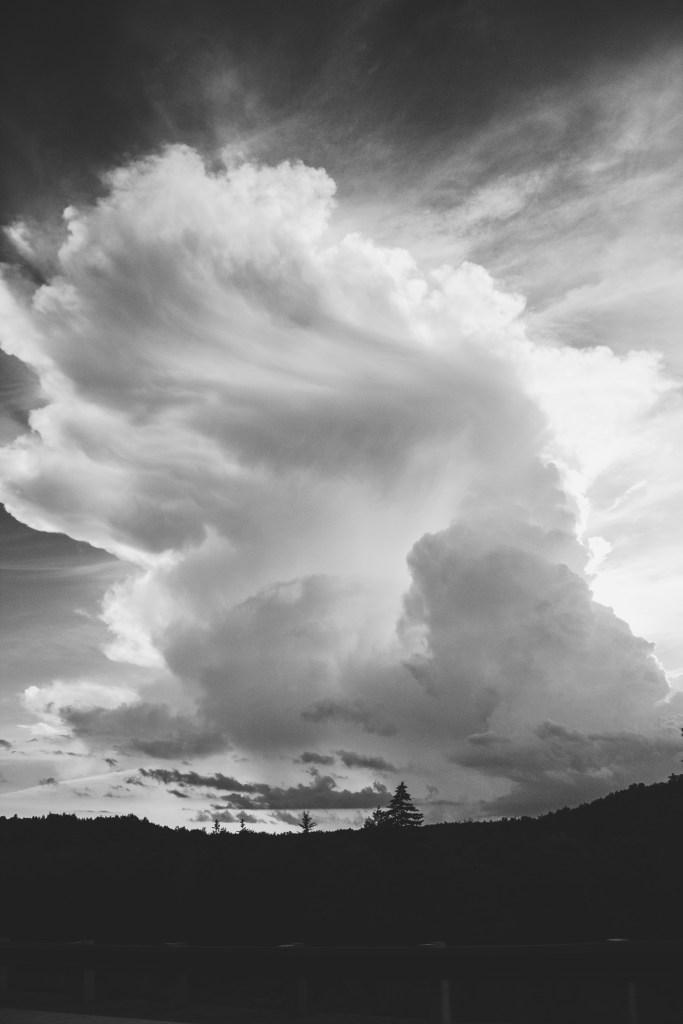
Photo Credit: Sean Foster carries mail in Hamilton, Ohio when it is light and at times, when it is dark. In 2022, he wrote something every day. In 2023, he began publishing on a small substack called typaphobe. Sean lives outside Cincinnati with his wife, daughter, and their boxer.
 L'Esprit Literary Review